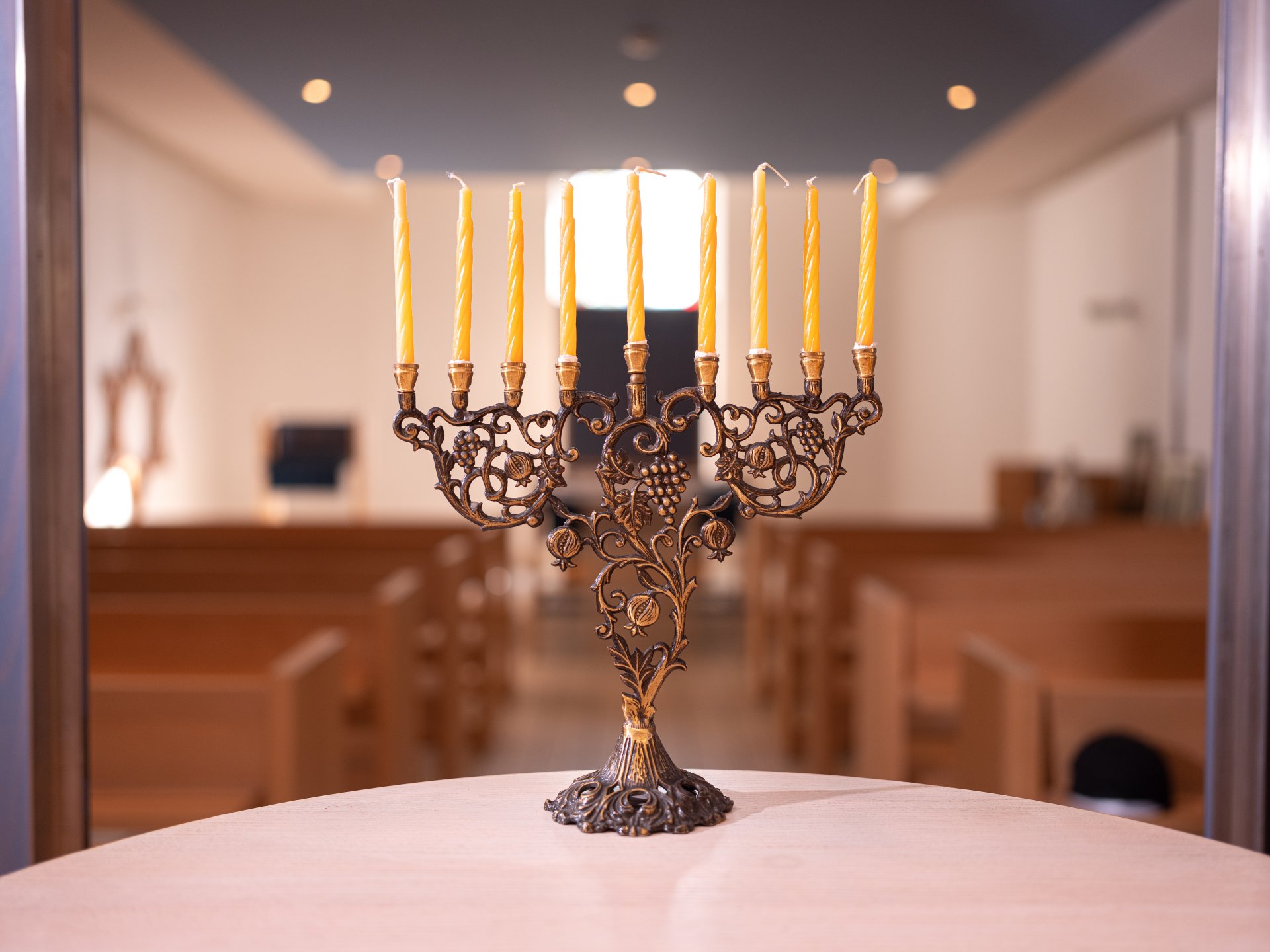
Menorah in front of the synagogue in the synagogue.
Diese Seite wurde automatisch übersetzt. Es kann daher zu Abweichungen oder Ungenauigkeiten im Text kommen. Verbindlich ist ausschließlich die Originalfassung. Rechtsansprüche aus Inhalten der übersetzten Version sind ausgeschlossen.

The Jewish community in Kitzingen

Jewish life was first documented in Kitzingen in the 13th century. Initially, smaller, partly private prayer rooms were used. In 1883, the prestigious synagogue between Landwehrplatz and the River Main was solemnly consecrated. It remained the spiritual and cultural centre of the Jewish community until its destruction during the Reich Pogrom Night of 1938, when its last members were deported in 1942. Since then, there has no longer been a Jewish community in Kitzingen.

Today, the Friends of the Former Synagogue in Kitzingen Association is dedicated to providing information about Jewish religion, history and culture, with a particular focus on the local region.

There is a lively culture of remembrance in the town of Kitzingen.

Friends of the former synagogue Kitzingen e.V.

The Friends’ Association was founded in 1982 to save the synagogue from demolition. It had been severely damaged during Kristallnacht. The four decades during which it was not renovated also took a heavy toll on the building’s structure.

Today, the Friends’ Association promotes Jewish culture and history through guided tours, lectures, concerts, theatre performances, exhibitions, excursions and other activities, such as the upkeep of the Jewish cemetery in Rödelsee.

A Jewish library and archive with around 2,000 volumes is also part of the Friends' activities. It is open outside the school holidays every Thursday from 16:00 to 18:00.

Overview by Elmar Schwinger

  • From the beginnings to the seizure of power in 1933

    There were already Jewish settlements in Kitzingen in the Middle Ages and early modern times. However, they remained episodic phenomena. During crises, bad harvests, epidemics, war or similar disasters, their members were expelled or even murdered. The penultimate Jewish community was expelled from the town in 1763 due to religious disputes.

    Under the influence of Enlightenment ideas, more Jewish-friendly legislation developed in Bavaria from the beginning of the 19th century. The revision of 1861, which granted free choice of profession and place of residence, freed Bavarian Jews from a paralysing shackle. The revision gave Kitzingen mayor Andreas Schmiedel (1859-1881) the opportunity to invite Jewish businessmen to help the declining wine trade, which had traditionally been the town's flagship and key industry, to flourish again.

  • Foundation of an Israelite religious community

    Younger, energetic Jews from the neighbouring communities accepted the invitation, so that on 1 January 1865 an Israelite religious community could once again be founded in Kitzingen. In order to create further incentives for Israelites, Mayor Schmiedel supported the relocation of the district rabbinate from Mainbernheim to Kitzingen.

    The influx of Jewish people into the district town continued for a long time. It was greatest in the 1870s and 1880s. Statistics record the highest number of Jewish citizens in 1910 with 478 Israelites. At that time, they made up 5.2 per cent of the total population, compared to the national average of just under one per cent. Migration to larger cities as a result of the generally changing economic situation, exacerbated by the declining birth rate, led to a negative population trend. In 1933, there were still 360 Jews living in the district town.

  • Economic upturn and awards

    The high number of wine merchants and büttners who did business in Kitzingen shows the extraordinary importance of this industry for the town, but it also sheds light on the organisational form of the business at the time. The address book of 1835 lists 20 wine merchants, the one of 1906 already 102, with the Israelites making up the majority with 52, which they expanded in the following years. This earned Kitzingen the nickname "town of 100 wine merchants". The Israelites were not represented in the growing number of büttners.

    Despite the subliminal reservations of some sections of the population, the Israelites in Kitzingen achieved a steep economic and social rise, which was reflected in social acceptance, public offices, awards and honours. Jews were even over-represented. Jews were called upon to serve as honorary jurors at the district court in Kitzingen at an early stage. They can be found in the local administration of the monarchical period as magistrate councillors and as members of the Collegium der Gemeindebevollmächtigten, and in the Weimar Republic as town councillors (the second chamber had been dissolved).

    The economic success of the Jewish wine merchants, butchers and bakers can be seen in the number of so-called "court titles", which testified to flourishing business operations, for example "Royal Bavarian Purveyor to the Court", "Grand Ducal Anhalt Purveyor to the Court", etc. These were professional seals of quality attesting to the seriousness of the business and the high quality of the products. This was a professional seal of quality that attested to the seriousness of the company's management and the high quality of its products. The aspirant could apply to the court by submitting a report from the city magistrate. The award was linked to the quality of the products, personal reputation, willingness to donate and other factors.

    There were around twelve court titles among the "Christian" and Jewish merchants in Kitzingen, with Jews being overrepresented here too. However, the most significant title in terms of social esteem was that of "councillor", which was awarded to two Jewish fellow citizens. The town applied to the government of Lower Franconia, which had to give its approval, enclosing a detailed report. In 1922, the practising doctor Dr Siegfried Öttinger was appointed a medical councillor, and in 1924 the wine merchant Max Fromm was appointed a commercial councillor.

  • Inauguration of the synagogue

    The inauguration of the magnificent synagogue in Landwehrstraße in September 1883, which was celebrated with a three-day festival, provided the occasion for the biggest celebration of the Israelites in Kitzingen over the course of time. The event seemed to symbolise the final achievement of equal rights and security for the Israelites. However, the First World War and, in particular, the Versailles Peace Dictate signalled a turning point in the acceptance of the Jewish population.

  • Deployment in World War 1

    The subliminal reservations, which had previously only affected limited circles, now became a majority opinion. The historical lie - "While the army bled to death in battle, the Jews shirked frontline service and enriched themselves back home through racketeering" - was not only disproved for Kitzingen by the number of Jewish soldiers honoured for frontline service. The wounded and fallen fellow believers also provide sad evidence. The memorial stone in the Rödelsee cemetery lists ten names, an eleventh was added later. Nevertheless, contrary to the truth, the slogan "the Jews are to blame for everything" became the credo of the NSDAP, an unscrupulous mass movement.

  • Weimar Republic

    The constitution of the Weimar Republic completed the rights and development opportunities of German Jews, but this was only met with cautious joy, as the political and social upheavals of the post-war period threatened the existence of the Jewish communities. The Bavarian Jewish communities, which sometimes diverged not only in their understanding of religion, rose to the challenge by founding the "Bavarian Jewish Community Association" in Nuremberg on 4 April 1920, which was given a parliamentary form of organisation in accordance with the democratic form of government. Two Jews from Kitzingen held offices in the highest committees, the district rabbi Dr Joseph Wohlgemuth and the wine merchant Eduard Sonder. The association represented the interests of its members to the outside world, defended them against attacks, supported the financially weak communities, promoted efforts to expand the restricted choice of professions in Jewish circles and looked after the Jewish unemployed, low-income families and individuals during the uncertain times. The Bavarian system soon became a model for other German states.

    Throughout Germany, the Weimar years were an era of great scientific and artistic achievements, in which German Jews were disproportionately involved. However, inflation and unemployment and the resulting political radicalisation led to profound disruptions and upheavals in society. Like the rest of the working population, the Jewish wine merchants in Kitzingen struggled to survive financially. Whilst entire sections of the population became impoverished, individuals amassed wealth through speculative business. In Kitzingen, two Jewish entrepreneurs managed to lead their companies to the very top of the industry despite the difficult conditions of the 1920s. The wine merchant Max Fromm catapulted his company to become one of the largest and most modern wine production sites in Germany through modern marketing and new forms of organisation.

    Samuel Hausmann, who converted goods wagons for the Reichsbahn railway accordingly, became a pioneer of beverage transport. Both entrepreneurs optimised their locations in 1929 by placing the company headquarters at transport hubs. Max Fromm moved to Bingen am Rhein, Samuel Hausmann positioned himself in Mainz. With the beginning of the Third Reich, the economic and social situation of Jews in Germany was to change fundamentally.

  • Oppression, persecution and extermination of the Jews of Kitzingen by the Nazi state

    When Hitler came to power on 30 January 1933, the smear campaign, which was now also carried out by state and municipal authorities, developed into an anti-Semitic conflagration. The calls for boycotts and riots, which had already darkened the Weimar years, were characterised by increasing viciousness and violence The anti-Jewish legislation excluded Jewish people from the economy and all areas of life. The so-called "Nuremberg Laws" of September 1935 were the preliminary climax of this development, largely cancelling out the rights of Jews that had been fought for in a long historical process. The riots, which escalated with each year, culminated in the "November Pogrom", the so-called "Reichskristallnacht".

  • Reichspogromnacht in Kitzingen

    The SA and SS, but also perpetrators from other backgrounds, broke into Jewish flats, smashed windows and doors, vandalised the furnishings, humiliated and tortured the residents. 99 people, including women and minors, were arrested and detained in the district court (today's surveyor's office). On 16 November 1938, after days of interrogation, the Gestapo delivered 35 Jewish Kitzingen residents to the district court prison in Würzburg, from where they were deported to Dachau concentration camp. There they were humiliated and abused until they agreed to immediately sell their businesses, practices and houses to "Aryans" and emigrate.

  • Deportations and flight after the November pogrom

    Since the November pogrom, the Jewish community in Kitzingen had been vegetating under humiliating conditions, impoverished and desperate. While the willingness to emigrate was only hesitant before the pogrom, it turned into desperate endeavours after the pogrom. A total of 192 people emigrated, 84 to the USA, 52 to Palestine, the rest spread across all continents except Africa. Those who were no longer able to emigrate, as well as those who did not want to leave their homeland, were deported as part of the nationwide deportations. Those who were able to work and their families were deported first. On 21 March 1942, 75 Jewish men and women from Kitzingen and 133 Israelites living in the city of Würzburg and the districts of Karlstadt, Kitzingen and Ochsenfurt were imprisoned and gathered at the "Fränkischer Hof" in Kitzingen.

    On 24 March 1942, a train made up of passenger coaches for this purpose deported them from Kitzingen via Nuremberg, where 792 other Jewish people were added, to the Izbica transit camp in eastern Poland. No one survived this transport. The last remaining Jewish residents of Kitzingen, 19 elderly men and women, waited for their "evacuation" in the so-called "Judenhaus" (today's archive and museum building). On 21 September 1942, a policeman escorted them to the train station, from where they were taken to Würzburg. The Gestapo assigned them to the transport that left for the Theresienstadt transit camp on 23 September 1942. Three women from the Kitzingen group were deported to Auschwitz, where they are missing. Three women survived the Theresienstadt transit camp. They are the only ones of the 94 Jewish Kitzingen residents deported from Kitzingen who survived the transports to Izbica and Theresienstadt.

    Converted to the total number, that is three per cent. Only Paula Sichel, who had run a kosher bakery with her husband in Rosenstraße, returned to her hometown for a short time before leaving to join her son who had emigrated to Australia. There is no longer a Jewish community in Kitzingen. The restored synagogue was rededicated on 19 May 1993. Former Kitzingen Jews were invited to the event by the town, which resulted in lasting contacts. There is a lively culture of remembrance in the town of Kitzingen

  • Sources

    • Naphtali Bamberger: History of the Jews of Kitzingen. Commemorative publication on the occasion of the 25th anniversary of the synagogue (1883 - 1908), Kitzingen 1908.
    • Elmar Schwinger: From Kitzingen to Izbica. Aufstieg und Katastrophe der mainfränkischen Israelitischen Kultusgemeinde Kitzingen, Kitzingen 2009: Deportation, transit camp, genocide. The exodus of the Main-Franconian Jews1941 - 1944.
    • Mainfränkisches Jahrbuch für Geschichte und Kunst, Part I 214, pp. 239 - 286, Part II (contains the transit and extermination camps): 1915, pp. 275 - 294.
    • Rotraud Ries and Elmar Schwinger (eds.): Deportations and processes of remembrance in Lower Franconia and at the destinations of the transports. Publications of the Johanna Stahl Centre for Jewish History and Culture in Lower Franconia, Würzburg 2015.
    • Memorial book Kitzingen. Yiskor. Researched by Michael Schneeberger with the collaboration of Christian Reuther and Elmar Schwinger, Kitzingen 2011.
    • Harald Knobling: The synagogue in Kitzingen. Geschichte - Gestalt - Bedeutung, Kitzingen 2003.

Help with accessibility

  • General

    We endeavour to make our website accessible. You can find details on this in our accessibility statement. You can send us suggestions for improvement via our feedback form Report accessibility.

  • Font size

    To adjust the font size, please use the following key combinations:

    Larger

    command
    +

    Smaller

    command

    Larger

    Ctrl
    +

    Smaller

    Ctrl
  • Keyboard navigation

    Use TAB and SHIFT + TAB to navigate through next/previous links, form elements, and buttons.

    Use ENTER to open links and interact with elements.

  • Contrast mode

    Press the following key combination to reduce or increase the contrast:

    Enlarge

    control
    option
    command
    .

    Decrease

    control
    option
    command
    ,
    Note: The shortcuts must be activated in the system settings of the operating system.

    Press the left ALT key + left SHIFT key + PRINT to quickly turn high contrast mode on or off.

  • Invert colours

    Press the following key combination to switch the colour inversion on and off:

    control
    option
    command
    8
    Note: The shortcuts must be activated in the system settings of the operating system.

    First activate the screen magnifier and then switch the colour inversion on and off with the following key combinations:

    1. screen magnifier

    +

    2. invert colours

    Ctrl
    Old
    I
  • Screen magnifier

    Press the following key combinations to use the screen magnifier:

    Switch on/off

    option
    command
    8

    Enlarge view

    option
    command
    =

    Zoom out view

    option
    command
    Note: The shortcuts must be activated in the system settings of the operating system.

    Switch on / Enlarge view

    +

    Zoom out view

Select language