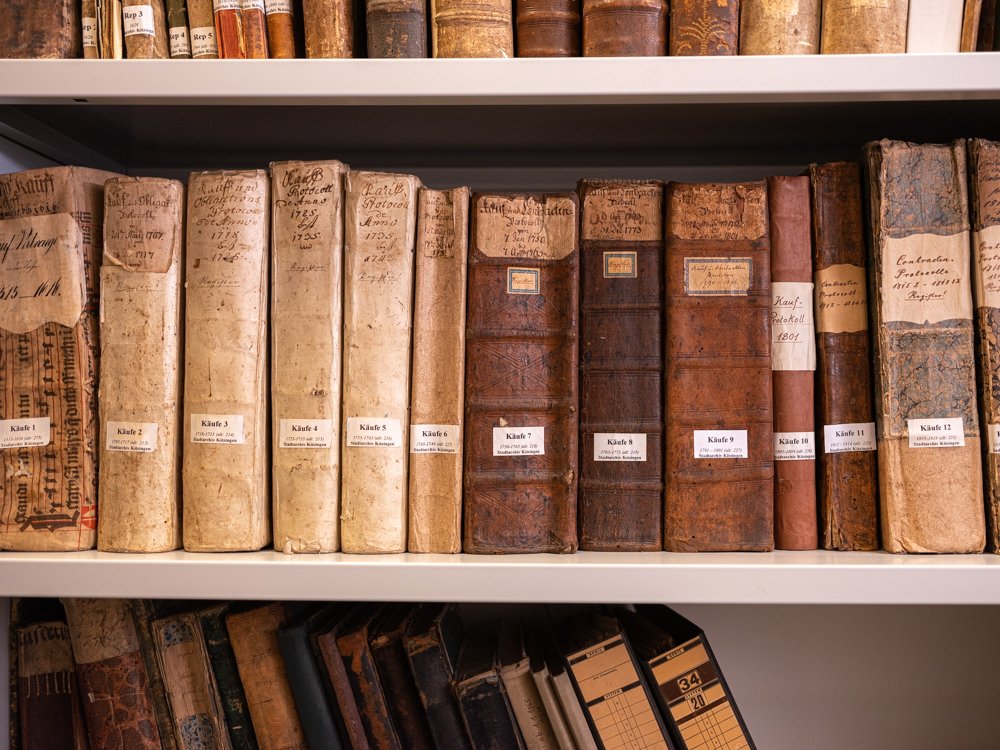
The Kitzingen municipal archive is the fourth most important municipal archive in the administrative district - after Würzburg, Schweinfurt and Aschaffenburg - due to its archival importance, the size and state of preservation of its holdings, but also due to the eventful history of the town itself.
City archive
Meaning
The city archive is the living memory of the city and the collection centre of its historical heritage that is accessible to everyone. It serves to safeguard, evaluate, catalogue and make accessible historical sources.
The city archive is a place
- urban history research
- regional and local history
- historical-political educational work
- family research
It is also the contact point
- for all those interested in history
- for city administration and authorities
- for researchers and historians
- for students in the context of scientific work
- for school classes during history workshops
User fees
Fees apply for private, family history and commercial research:
On presentation of one archival unit € 4.00, two € 7.00, three € 9.00 and four € 10.00.
Each additional unit is charged at €1.00. Expert opinions are charged at €15.00 per 30 minutes.
Stocks
In addition to the history of the town of Kitzingen, the holdings of the town archive also cover the history of the surrounding area. The almost 800 shelf metres of documents did not suffer any significant losses during the Thirty Years' War (1618-1648) and the Second World War (1939-1945).
Listing of stocks
- Documents since the 14th century, including valuable imperial documents
- Council minutes since 1525
- Chronicles, including the well-known Bernbeck Chronicle from 1549
- Official records, court and judgement books
- Family and guardianship registers and birth certificates since 1463
- Markungsbücher, Urbare
- Sources on the confessional conflict after the redemption of the pledged city in 1629
- Invoices and receipts relating to the Thirty Years' War
- Volumes on contribution payments during the French Revolutionary Wars
- Files of the city magistrate and city council, 1800 to 1955
- Emigration and immigration files
- Civil rights files, 1800 to 1918
- School records
- District court and district office files
- Master books of various trades
- Books of fours and tens, treasury and tax books
- Sovereign mandates, collections of laws and ordinances
- Minutes of the Poor Law Council
- Various club minute books
- Invoices and records of the town of Kitzingen, its various foundations and treasuries
- Kitzingen hospital collections (15th to mid-20th century)
- Birth, marriage and death registers, family records since 1876
- Kitzinger Zeitung (since 1831; digitised since 1900)
- Poster collection
- Historical photo archive
- Building plans from the turn of the 20th century
- Media archive (digitised films and audio contributions), starting in 1925
Publications
Volume 1: The works of the baroque master builder in Kitzingen
Balthasar Neumann's architecture is recognised by art historians as the "glorious final chord of the European Baroque". The name of the master builder from Eger is associated with works such as the Residenz in Würzburg, the pilgrimage church of Vierzehnheiligen in Upper Franconia and Brühl Palace in the Rhineland, to name just a few of his major works. This publication traces the architectural achievements of Balthasar Neumann in the town of Kitzingen. Mention is made not only of the famous Chapel of the Cross in Etwashausen, but also of the Protestant parish church of St Michael, the baroque spire of the Catholic parish church of St Johannis, the barracks for poor and sick soldiers of the High Abbey of Würzburg, the repair work on the Old Main Bridge and the construction of the warehouse and crane on the banks of the Main.
Volume 1: Erich Schneider, Balthasar Neumann (1687–1753). The Works of the Baroque Architect in Kitzingen. Kitzingen 1989. Edited by Helga Walter. ISBN 3-921327-21-0. Unfortunately out of print!
Volume 2: "Thus saith the Lord". The tradition of the Bible in Kitzingen
The year 1992 was designated the "Year of the Bible" by both major Christian churches. Kitzingen, whose town's history particularly reflects the interplay, but also the disputes between the churches, has another reason to celebrate the "Book of Books". In August 1562, Paul Eber, a reformer born in Kitzingen and a pupil of Melanchthon, gave his hometown a two-volume Bible on the occasion of the construction of the town hall. This was the reason for this publication as well as an exhibition, also organised in 1992 in the town hall, both of which were intended to commemorate the Bible tradition in Kitzingen. The Paul Eber Bible and other selected copies from Kitzingen and the surrounding area are presented and explained in this anthology in order to familiarise readers with aspects of the understanding of the Bible in an ecumenical spirit.
Volume 2: Herbert Baumann, Walter Platzöder, Ludwig Ruf, Siegfried Schindler, Christoph Schmerl, Svetozar Sprusansky, Helga Walter, Isaiah Wohlgemuth, "Thus Says the Lord". On the Tradition of the Bible in Kitzingen. Kitzingen 1992. Edited by Helga Walter.
ISBN 3-921-327-23-5. Unfortunately out of print!Volume 3: The town hall of Kitzingen, built 1561-1563 - a symbol of self-confident bourgeoisie
In 1994, the town of Kitzingen celebrated a memorable anniversary: 650 years of Kitzingen Town Hall. The history of the town hall is closely linked to the history of the town and also to Franconian and imperial history. Three factors complicated the legal situation: firstly, that Kitzingen was mortgaged in the 15th century and thus had two town lords; secondly, that the town hall was the property of the monastery; and finally, that the monastery itself did not belong to any of the town lords, but to the diocese of Bamberg. The focus of the study is the history of the building, and with it the town's building system, which has not yet been dealt with in this detailed form. In addition, the functions of the town hall in legal and public life as well as the tasks of the council and the town administration are also at the centre of interest.
Volume 3: Helga Walter, The Town Hall of Kitzingen, built 1561–1563 – A Symbol of a Self-Assured Bourgeoisie. Kitzingen 1994. Edited by Helga Walter. ISBN 978-3-924694-30-2. Second edition 2013. Price: €24.50.
Volume 4: 1250 years of Kitzingen am Main - "apud Kizinga monasterium"
This beautiful anthology of the town's history was published on the occasion of the 1250th anniversary of the town of Kitzingen in 1995. Renowned scientists, local historians and Kitzingen theologians deal with completely different aspects of the town's history. Clearly written and vividly illustrated, they cover a wide range of topics from prehistory and early history (Dirk Rosenstock) to the Middle Ages and modern times. The future development of this town is also addressed in individual contributions. The historical contributions begin with the monastery (Klaus Arnold). Other topics include the economic and social structure of the town at the beginning of the 16th and 17th centuries (Klaus Arnold, Gerhard Rechter), the geographical development of Kitzingen (Dieter Böhn), the Catholic reform in Kitzingen (Herbert Baumann) and the social commitment of the Protestant community at the turn of the 19th century (Christoph Schmerl). Kitzingen on its way into the 21st century (Erwin Rumpel) as well as art history articles on small art monuments (Hans Bauer), art and artists (Erich Schneider) and the municipal museum (Helga Walter).
Volume 4: Klaus Arnold, Hans Bauer, Herbert Baumann, Dieter Böhn, Gerhard Rechter, Dirk Rosenstock, Erwin Rumpel, Christoph Schmerl, Erich Schneider, Helga Walter, 1250 Years of Kitzingen am Main – “apud Kizinga monasterium”. Kitzingen 1995. Edited by Helga Walter.
ISBN 3-921327-25-3. Unfortunately out of print!Volume 5: From the shadow of the monastery to the city on the Main
This volume follows on from the anniversary volume from 1995 and focuses on the history of Kitzingen from the foundation of the monastery to the end of the Middle Ages. The early days and Middle Ages of the town of Kitzingen were characterised by the monastery and the disputes with it. It was an act of "Christian charity" that caused the name "Kitzingen" to appear in the chronicles for the first time: in the biography of Abbot Sturmi from Fulda, it is reported that he fell ill on his return from a pilgrimage to Rome and was nursed back to health by nuns in the monastery, which had already been founded at the time. This event in the year 748 proves the existence of the monastery as the later nucleus of the town and Kitzingen comes into the light of history. The appendix contains sources on the history of the monastery, including the list of property around 1070 translated into German, a list of the abbesses of the monastery (date of their documentary mention, indication of the source) and a list of the oldest Kitzingen documents up to 1200.
Volume 5: Klaus Arnold, 1250 Years of Kitzingen. From the shadow of the monastery to a town on the Main. Kitzingen 1996. Edited by Helga Walter.
ISBN 3-921327-26-1. Unfortunately out of print!Volume 6: The synagogue in Kitzingen. History - Shape - Meaning
With this book, the Kitzingen art historian Dr Harald Knobling has made a very important contribution to the history of the town, in which the art-historical, historical and sacred significance of this building is honoured. The Kitzingen synagogue is one of the few larger Israelite sacred buildings that largely survived the Reichskristallnacht in its structural design. It is even the only larger synagogue in Lower Franconia. This work fills a gap in the research of synagogue architecture of the late Gründerzeit. A circumstance that justifies its very detailed and comprehensive architectural-historical analysis of the building's exterior and interior, its architectural appreciation and its stylistic-historical categorisation within the architecture. It is particularly noteworthy that the sometimes remarkable official speeches given at the opening of the building have been preserved for posterity in an appendix.
Volume 6: Harald Knobling, The Synagogue in Kitzingen: History – Architecture – Significance, Kitzingen 2003. Edited by Doris Badel.
ISBN 3-924694-18-4. Price: €16.80.Volume 7: Study support in Kitzingen from the Reformation to the Thirty Years' War
Martin Riegel's dissertation on student support in the town of Kitzingen, which has been published as volume 7 of the "Schriften des Stadtarchivs Kitzingen", is based on several years of intensive source studies. The author deals with a topic that, although it dates back 500 years, has not lost its topicality, especially in the light of recent discussions about the ongoing education crisis in the Federal Republic of Germany. In the course of the Reformation, an independent municipal scholarship system was established in Kitzingen on the financial basis of generous civic foundations. The town council thus had an institution that pursued two educational policy goals. On the one hand, the aim was to provide financial support for the further education of talented but unfortunate citizens' sons at secondary schools and universities, and on the other, to secure the next generation of clergymen and teachers in the town. This work presents the foundations and donors of the scholarships as well as their motives, analyses the municipal scholarship system in theory and practice, looks at the special role of Paul Eber in the care and supervision of his Kitzingen scholarship holders in Wittenberg, and traces the studies as well as the social background and professional careers of the students in detail.
Volume 7: Martin Riegel, Scholarly Research in Kitzingen from the Reformation to the Thirty Years’ War, Kitzingen 2006. Edited by Doris Badel.
ISBN 3-924694-19-2. Price: €19.90.Volume 8: Councillors and citizens. Chronicle of the Schmidt of Kitzingen 17th-19th century
Volume 8: Walter Poganietz, Councillors and Citizens. A Chronicle of the Schmidt Family of Kitzingen, 17th–19th Centuries, Kitzingen 2007. Edited by Doris Badel. ISBN 978-3-924694-20-3. Price: €19.90.
Volume 9: From Kitzingen to Izbica. The Rise and Catastrophe of the Main-Franconian Jewish Community of Kitzingen
In the 1860s, the mayor of Kitzingen, Andreas Schmiedel, brought Jewish merchants to the town to revitalise the declining wine trade. The Jewish immigrants arrived full of energy, founded a religious community and built the magnificent synagogue in Landwehrstraße in 1883. Their economic and social rise reached its peak at the beginning of the 20th century, which was reflected in the largest membership of almost 500 souls. The catastrophic defeat of the First World War and the subsequent economic collapse demanded a "scapegoat". The Nazis spread the lie: "The Jews are to blame for everything!" When Hitler came to power, the course was set: First came the disenfranchisement and expropriation by law, then a barbaric act of terror, the November pogrom of 1938, plunged fellow Jews into mortal fear and despair. In the end, the 94 Jews from Kitzingen who had been unable to emigrate were deported. This book contains a series of previously unpublished findings that go beyond regional borders and are based on the analysis of countless sources from domestic and foreign archives. On several private trips to Israel, Poland, the Czech Republic, Latvia and the USA, the author conducted extensive interviews with Jewish contemporary witnesses and examined documents from their families. In Latvia, the Czech Republic and Poland, with the support of survivors and local experts, he retraced the horrific fate of the Main Franconian Jews in the former transit ghettos and extermination camps.
Volume 9: Elmar Schwinger, From Kitzingen to Izbica. The Rise and Fall of the Kitzingen Jewish Community in Main-Franconia. Kitzingen 2009. Edited by Doris Badel. ISBN 978-3-924694-21-0. Price: €19.80.
Volume 10: Catholic parish church of St John in Kitzingen. Contributions to church and art history
The Catholic parish church of St John was consecrated in 1487 after decades of construction by Würzburg Prince-Bishop Rudolf II von Scherenberg. The church, built on the foundations of an earlier Romanesque church, is one of the most remarkable late Gothic church buildings in Franconia with its numerous sculptures from different centuries. It is the oldest surviving cultural monument in Kitzingen and also the town's most important sight. To mark the 525th anniversary of the consecration of the parish church, the "School, Education and Adult Education" committee of the parish council, under the leadership of Dr Harald Knobling and Maria Stegmann, organised a series of lectures at the end of 2012, for which renowned speakers from various specialist areas were recruited. They are either closely connected to the parish of St John or are proven experts on the history of the church and the town. This volume brings together a total of seven scholarly contributions in its thematic and chronological references, which are closely related to the building itself, its rich artistic treasures and the history of the parish and town community. Despite different questions and perspectives, there are overlaps and a number of internal references between the various essays, which bring the publication together into a coherent whole.
Volume 10: Klaus Arnold, Harald Knobling, Erich Schneider, Christoph Schmerl, Maria Stegmann, Herbert Baumann, Adolf Mörtl, The Catholic Parish Church of St John in Kitzingen. Essays on Church and Art History. Kitzingen 2016. Edited by Doris Badel.
ISBN 978-3-924694-37-1. Price: €19.80Volume 11: Harald Knobling, Kitzinger Stadtgrün. Yesterday-today-tomorrow.
This article by art historian and town curator Harald Knobling on a hitherto little-noticed topic of town history sheds light on the beginnings and development of urban greenery in Kitzingen with a wealth of knowledge and sources. The book ranges from the first initiatives of the middle classes as creative protagonists of an aesthetic cityscape enhanced by green spaces to the projects of the Kitzingen Beautification Association and the outlook for future urban plans to increase the quality of life through more greenery. The author focusses on the development of this civic commitment to urban greenery in Kitzingen, which was brought together by the founding of the non-profit Verschönerungsverein in 1879. The most important project of this association was the planning and construction of the Obere Anlagen. The history of the creation and development of this Kitzingen town park near the Schützenhaus above the railway station is the central theme of Harald Knobling's study of Kitzingen's town greenery.
Volume 11: Harald Knobling, Kitzingen’s Urban Greenery: Yesterday, Today, Tomorrow. Kitzingen 2023. Edited by Doris Badel.
ISBN 978-3-924694-40-1. Price: €14.90.
Further publications
700 years of the Old Main Bridge in Kitzingen
This publication by the town archives in collaboration with the Kitzingen artist K.D. Christof is dedicated to the Old Main Bridge as a building of historical importance to the town. For the first time, a richly illustrated documentation with informative texts traces the eventful fate of this bridge in an understandable and entertaining way. It spans from the legend of Hadeloga and King Pippin to the famous engraver Matthäus Merian and the ingenious master builder Balthasar Neumann to the present and the near future. This richly varied volume pays lasting tribute to the Old Main Bridge on the occasion of its first documented mention in 1300.
Doris Badel, K.D. Christof, 700 Jahre Alte Mainbrücke Kitzingen. Kitzingen 2000, unfortunately out of print.
A pretty little card, a fine little card ... Kitzingen 100 years ago in old views
This beautiful and richly illustrated publication shows 120 historical views of Kitzingen and its neighbourhoods. Many of these impressive photographs could already be admired in the highly acclaimed exhibition in January 2010, and some new ones have now been added. The exhibition presents old postcards, the oldest dating back to 1892, which document sometimes unusual perspectives of Kitzingen and its incorporated districts. The focus is not only on the view itself, but also on the connection between text and image. Who were the people who wrote these cards, what fates are hidden behind them, what was written or why were the cards sent? This publication not only aims to be a contribution to the history of the city, but also to give the viewer pleasure when leafing through it again and again.
Doris Badel, Klaus Arnold, A lovely little card, a fine little card ... Kitzingen 100 years ago in old views. Kitzingen 2010. Published by Kitzingen Municipal Archives. ISBN 978-3-924694-24-1
Best regards from the beautiful town... Kitzingen views tell
We are delighted to present the long-awaited follow-up volume "Best greetings from the beautiful town ... Kitzingen views tell" to the 2010 publication "Ein Kärtlein schön, ein Kärtlein fein ...". The current illustrated book focuses on people and their everyday lives. It presents rare old views of the town, greetings and advertising cards, cards of anniversaries and festivities, restaurants, monuments, buildings, streets and also field postcards from the First World War, which give a glimpse of what Kitzingen used to be like. The oldest picture postcard was sent in 1894, the most recent in the war year 1940. However, the interest of the Arnold-Badel team of authors lies not only in the view itself, but even more in the people behind it. What connected them and what did they write to each other? As with the first volume, the viewer can compare the historical picture with the current one and decide for himself which he likes better. We hope you enjoy leafing through Kitzingen's past!
Klaus Arnold, Doris Badel, Warm regards from the beautiful town... Kitzingen Views. Kitzingen 2014. Published by Kitzingen Town Archives. ISBN
978-3-924694-34-0 Available in bookshops, and also on sale at the Town Hall and the Town Archives. Price: €14.80.