View of the Old Synagogue in Kitzingen
Diese Seite wurde automatisch übersetzt. Es kann daher zu Abweichungen oder Ungenauigkeiten im Text kommen. Verbindlich ist ausschließlich die Originalfassung. Rechtsansprüche aus Inhalten der übersetzten Version sind ausgeschlossen.

Buildings

Buildings in Kitzingen

Town hall on the market square

The town hall on the market square is one of the most important historical buildings in Kitzingen. It was built in the 16th century by the master builder Hans Eckart von Schaffhausen and designed in the Renaissance style. The building symbolises Kitzingen's economic importance as a wine trading town.

The façade is richly decorated with elements. The cubit refers to the town's measuring and market system. The coat of arms of the Margraviate of Brandenburg-Ansbach is a reminder of the town's former sovereign affiliation. The "Häcker" is clearly visible at the top of the front of the building on the corner and symbolises viticulture.


Half-timbered houses

Kitzingen’s market square is framed by magnificent half-timbered houses that bear witness to the rich history of this former wine-trading town. Particularly eye-catching is the red-and-white Poganietz House, a Renaissance half-timbered building dating from 1556. Today it houses the Confectionery Museum, the entrance to which is located in the Röser bakery.

Market tower

Opposite the town hall is the round market tower, which dominates the market square with its height of 39 metres and octagonal spire. The tower was originally part of the inner city wall and served as both a watchtower and a prison.

Over time, the Marktturm was used for a variety of purposes, including as the central archive of the German carnival organisation Fastnacht. An office was located here until it was moved to the carnival building in Rosenstraße.

The base of the tower is surrounded by small shops, which blend it harmoniously into the hustle and bustle of the market square. During the Christmas season, the market tower takes on a very special significance: it becomes Bavaria’s largest Advent candle.

Falter tower

In the mid-15th century, Margrave Albrecht of Brandenburg-Ansbach had an outer wall built around the town of Kitzingen. This consisted of a wall, a moat and 32 towers with a total of four gates. The largest tower still standing is the Falterturm (formerly ‘Falltorturm’) with its sloping dome, which was built between 1469 and 1496 as a watchtower for the outer city wall. The ivy-covered round tower stands 52 metres high, with its foundations reaching 18 metres deep due to the former city moat. Since 1967, it has no longer housed the watchman who used to report fires and horsemen, as in the old days, but instead housed the official German Carnival Museum until 2011.

There are many stories surrounding the Falterturm’s crooked spire; here are a few of them: Due
to a shortage of water during the construction of the Falterturm, the mortar is said to have been mixed with wine. It is said
that during the construction of the spire, the carpenters had a few too many drinks, which is why the dome was built crooked.
At the wedding of a councillor’s son from Kitzingen, which took place by the city wall, the Falterturm – which had previously stood straight – bowed before the bride, a maiden from Sulzfeld. The tower congratulated her on her handsome groom and said: “When another maiden comes to Kitzingen, I shall stand upright again.” No maiden has come to Kitzingen for over 500 years…
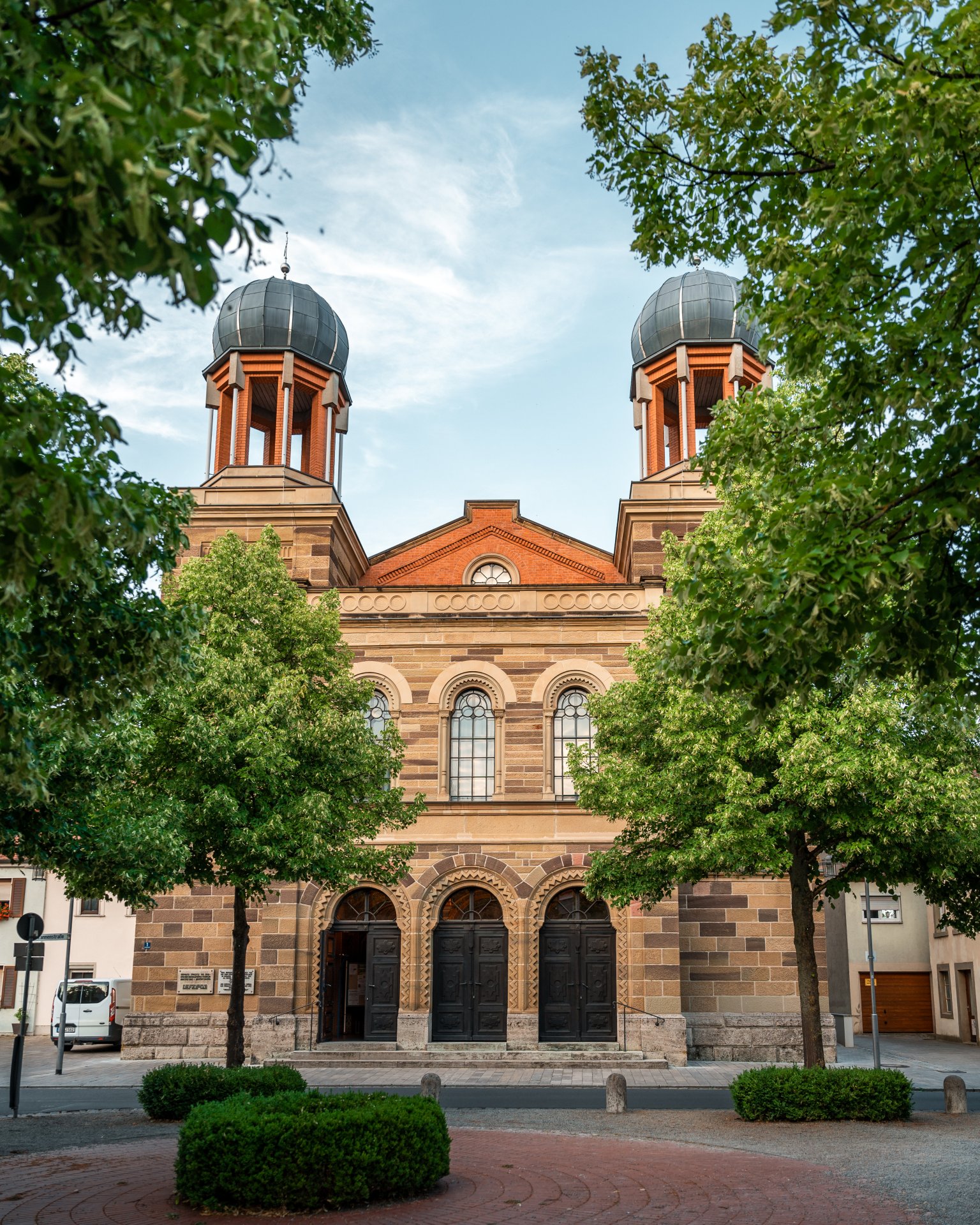
Old Synagogue Culture Centre

Built between 1882 and 1883, the synagogue serves as a reminder of the town’s once-thriving Jewish community. Its exquisite interior and the domes of its towers were destroyed during the ‘Night of Broken Glass’ on 10 November 1938. Following its reconstruction, the synagogue is now used primarily for cultural purposes.

Old Main Bridge

The Old Main Bridge in Kitzingen, also known as "Pippinsbrücke" and part of the town's coat of arms, is one of the few Main bridges in Lower Franconia with medieval origins. It was first mentioned in a document in 1300 and was built by the citizens of Kitzingen themselves.

The bridge used to be secured by gates and a customs house stood in its centre. There was even a public toilet, the so-called "Cloaca publica", attached directly to the bridge - the Main River practically did the flushing back then.

In 1955/56, the centre section of the bridge was widened and adapted to modern shipping.

Luitpoldbad

After the discovery of a rich brine spring, which today feeds the indoor brine pool ("aqua-sole Kitzingen"), opened in 1977 and renovated in 2009, Kitzingen was to become a bathing town. To this end, the "Prinzregent-Luitpold-Bad" was built in Art Nouveau style and inaugurated in 1914. The public baths were donated by wealthy citizens of Kitzingen, as 100 years ago there were only 3 bathtubs for every 9,000 inhabitants of the town (a common figure in Germany at the time). Brochures were even printed advertising a blue-tiled bathroom "for the nervous and water-shy". However, the plan for a "Bad Kitzingen" with a promenade or promenade was never realised due to the outbreak of the First World War in 1914. The public baths with their showers and bathtubs were used until the 1970s. Since 1982, the building has been used as an adult education centre and public library.

Deuster tower

The Deuster Tower once formed part of Deuster Castle, also known as the ‘Little Nun’s Castle’. Whilst the castle was almost completely destroyed during the air raid on Kitzingen on 23 February 1945, the tower survived. Today, a school complex stands on the former castle grounds, and the tower itself houses an ornithological exhibition. A 600-year-old vaulted cellar has also been preserved and can be viewed as part of the “Kitzinger Kostproben” guided tour.

The complex looks back on an eventful history: from the official residence of the Margraves of Brandenburg-Ansbach to the ownership of a Benedictine convent and the wealthy Deuster wine merchant family. This family left a lasting mark on Kitzingen as patrons and benefactors of the town. Under Carl Reichard von Deuster, the castle was given the name "Schloss Friedenstein" in 1884. The tower even served as an astronomy tower at times.

The preservation of the Deuster Tower was controversial in the 1960s. Despite high renovation costs, the city council narrowly decided in favour of its preservation in 1962.

Help with accessibility

  • General

    We endeavour to make our website accessible. You can find details on this in our accessibility statement. You can send us suggestions for improvement via our feedback form Report accessibility.

  • Font size

    To adjust the font size, please use the following key combinations:

    Larger

    command
    +

    Smaller

    command

    Larger

    Ctrl
    +

    Smaller

    Ctrl
  • Keyboard navigation

    Use TAB and SHIFT + TAB to navigate through next/previous links, form elements, and buttons.

    Use ENTER to open links and interact with elements.

  • Contrast mode

    Press the following key combination to reduce or increase the contrast:

    Enlarge

    control
    option
    command
    .

    Decrease

    control
    option
    command
    ,
    Note: The shortcuts must be activated in the system settings of the operating system.

    Press the left ALT key + left SHIFT key + PRINT to quickly turn high contrast mode on or off.

  • Invert colours

    Press the following key combination to switch the colour inversion on and off:

    control
    option
    command
    8
    Note: The shortcuts must be activated in the system settings of the operating system.

    First activate the screen magnifier and then switch the colour inversion on and off with the following key combinations:

    1. screen magnifier

    +

    2. invert colours

    Ctrl
    Old
    I
  • Screen magnifier

    Press the following key combinations to use the screen magnifier:

    Switch on/off

    option
    command
    8

    Enlarge view

    option
    command
    =

    Zoom out view

    option
    command
    Note: The shortcuts must be activated in the system settings of the operating system.

    Switch on / Enlarge view

    +

    Zoom out view

Select language