Candy factory Wildhagen
Wildhagen
Sweet Factory: A Brief History
The foundations for the residential building, the mill and the boiler house of what would later become the Wildhagen sweet factory on Glauberstraße and Kanzler-Stürtzel-Straße were laid by Heinrich Metzges (1821–1883), a silk manufacturer from Krefeld, who married Maria Emma Sander, a descendant of the well-known Kitzingen wine merchant family Sander. As early as 1853 and 1855, he applied to the town magistrate for permission to build a steam mill. However, as the municipal mill on the Main still existed at that time, both applications were rejected. The old Main mill was, however, due to be demolished because it obstructed shipping. Once the issue of compensation had been settled between the town of Kitzingen and the Bavarian Treasury, Metzges finally succeeded with a third application, dated 1 April 1857, for a personal licence. However, whilst the town and the Treasury were still in litigation, Metzges decided to build his steam mill near the town and to forego the purchase of the Main mill.
However, his entrepreneurial visions went further. On 22 March 1858, while the steam mill was still being built, the Kitzingen magistrate allowed him to build a sawmill next to the steam mill, the boiler of which was the second in Kitzingen to be put into operation in the same year. In 1864 he built a bread factory, in 1868 he introduced gas lighting to his business, in 1869 he built his residential building with the striking stepped gable on the corner of Glauberstraße and Kanzler-Stürtzel-Straße, in 1875 he installed a second steam boiler and finally in 1877 he built a cement distillery.
The unusually enterprising man died on 5 August 1883 and his name is directly associated with the beginning of industrialisation in Kitzingen. After his death, the business passed to the banker Kommerzienrat Georg Bachmann, August Wildhagen's father-in-law.
Together with August Wildhagen, Bachmann founded the "Chocoladefabrik Wildhagen A. & Cie." on 25 August 1884, which was located at Bahnhofstrasse 848 (Bahnhofstrasse 11 since 1900). This address was identical to that of Bachmann's "bank and exchange business". Wildhagen initially took over the general distribution for Germany and Luxembourg for the Swiss sweet factory Jacques Klaus in Locle and imported the Swiss sweets from the factory of the then young parent company, which was groundbreaking for the qualitative improvement of German sweets, as the sweets were without fruit flavour or fruit acid at the time.
After Georg Bachmann retired from the company management in 1886, he was replaced by Hermann Wildhagen, who had been a partner since 1 August 1885. The two brothers founded the "Confiseriewarenfabrik A. Wildhagen & Co." at Dampfmühlstraße 816/818 (since 1900 Wörthstraße 25, after the extension of Kanzler-Stürtzel-Straße begun in 1902: Kanzler-Stürtzel Straße 2/2a) as a general partnership and started their own production of sweets in autumn 1887 using the well-known recipes of the Swiss Jacques Klaus. To this end, they built a new factory in the rooms next to the steam mill. Two years later, the Wildhagens also took over the operation of the steam mill itself, which was no longer operated as a grain mill but was used to grind clay for the Pfirschinger Mineralwerke, which they founded in 1905. What was special about the production of sweets at the time was the vacuum cooking process. This technology allowed for higher productivity and finer products than conventional manufacturing.
The company suffered severe setbacks during the war and in the post-war years. For instance, the Pfirschinger Mineralwerke was completely destroyed during the bombing raid on Kitzingen on 23 February 1945. Around 100 bombs levelled the buildings and facilities of the Mineralwerke north of the Nuremberg railway bridge, causing damage amounting to just under one million marks. The sweet factory and the residential building were occupied when the Americans moved in; the District Resident Officer had his headquarters in the administration building, the American military court also held its sessions there, and the largest factory room housed the ‘commissary’ for the American occupying forces. A double staircase was erected on the outer façade facing the Main, and from early morning until late at night, the American Army’s provisions were collected here.
It was only after years of difficult negotiations that Wildhagen succeeded in regaining control of key parts of his factory in 1949. The decisive factor was that the company, at its own expense, erected a large barrack on Kanzler-Stürtzel-Straße opposite its factory building to relieve the pressure on the American warehouse within the factory. This enabled production to resume on a smaller scale on 1 July 1949.
A branch of Pfirschinger Mineralwerke was also able to recommence production in 1950. At this time, Richard Wildhagen, who had been the sole owner since the death of his uncle and company founder August Wildhagen in 1932, was serving as Kitzingen’s honorary mayor and devoted all his energy and passion to the reconstruction of the war-ravaged town. It is certain that, in the crucial post-war years, certain opportunities were missed regarding the fresh start and the resumption of production at the sweet factory. By the time operations were fully resumed and modernised in 1953 – after eight years of requisition – it was, in fact, already too late. The company had by then lost its domestic and foreign clientele as well as its business partners, and experienced staff were no longer available. The opportunity had been missed for good.
From 1960 onwards, Wildhagen sought and found ways out that involved various external companies, but these were ultimately unable to save the situation. In 1960, he sold the business to Horst Bentz, then owner of the Melitta Group, but just three years later it was sold on to August Storck KG, until production had to be ceased entirely by the end of 1969. Richard Wildhagen retired to a life of leisure, and his son Hasso took up the post of director at a large confectionery firm in Saarbrücken. Pfirschinger Mineralwerke ceased operations in 1971.
Until the company went out of business, Wildhagen sweets enjoyed an excellent reputation, not only in Europe but also overseas. In the heyday of the Wildhagen company, the natural jams for the fillings of Wildhagen sweets were processed by the tonne every day. The amount of sweets produced per day was 4,250 kilos. The carefully wrapped sweets, speaker's pastilles and Lingua menthol sweets went all over the world in original and modern gift packaging. Wildhagen's sour candies were known as vitamin drops on all fronts during both world wars, especially during the Second World War, and were thus on a par with the bear gingerbread made by Schmidt Bros. in Mainbernheim and Arauner's artificial honey from Kitzingen.
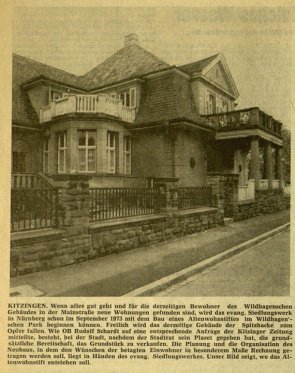
The castle-like Villa Wildhagen, built in 1914 at 1 Mühlbergstraße by August Wildhagen in the Neo-Baroque style, with its park covering almost 4,000 square metres and an idyllic garden pond with a fountain, which had been sold to the town of Kitzingen in the 1930s, was due to make way in 1973 for a new building housing a care home with a senior citizens’ club and underground car parks, for which the Evangelische Siedlungswerk intended to take responsibility. The Kitzingen Town Council also supported this measure; only the Kitzingen Cultural Society spoke out in favour of preserving this magnificent estate and urged the future owners to integrate the building, with its stucco ceilings, into the wider complex, as older people in particular would feel more at home in such surroundings than in austere, functional concrete blocks. Fortunately, the Evangelical Housing Association abandoned its plans as early as the end of 1973, as the project was, on the one hand, too expensive and, on the other, the need for care facilities for the elderly in Kitzingen was not considered to be particularly high.
Further planning by the city now envisaged the expansion of the villa to accommodate staff flats and care facilities as well as a centre for the elderly. New extensions were only planned for the older residents. On 11 November 1976, the town of Kitzingen finally sold the entire property at Mühlbergstraße 1, including the park and ancillary facilities, to the Diakonisches Werk Kitzingen e.V. for DM 800,000 to build flats for the elderly. In 1986, the retirement and nursing home was thoroughly renovated and given a modern extension. Today, the beautiful stately villa and its extension house the "Haus Mainblick" nursing home for the elderly run by the Diakonie organisation.
The remaining properties of the former candy factory in Glauberstraße were transferred to the fashion house "Jakob Heyer" in April 1973. Heyer ran a department store-like business in Dettelbach, focussing on the textile market, where he sold cheap textiles and special items at bargain prices. The conversion work was supposed to be completed and the shop opened by Christmas 1973, but Heyer was unable to realise his plans in Kitzingen. The factory's 34-metre-high chimney was nevertheless blown up on 10 April 1974. In the following years, the sign and stamp factory "Astorga Fritz Lange GmbH" operated its business here until both the residential building and parts of the former Wildhagen factory building (around 1000 square metres) were offered for sale to the town of Kitzingen by the then owner Kurt Stellwag from Würzburg in the summer of 1984. In the interest of improving traffic conditions at the junction of Kanzler-Stürtzel-Straße and Glauberstraße, the town entered into sales negotiations to purchase the offered property complex for demolition. On 30 October 1984, the decision was made to purchase the entire complex. However, there was still disagreement regarding the demolition and the need to straighten Glauberstrasse at this junction.
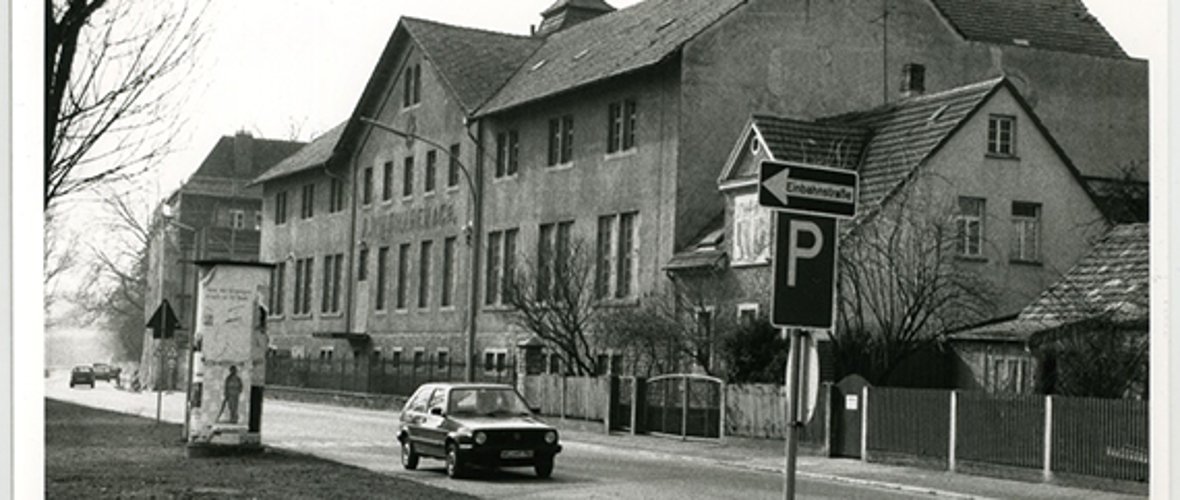
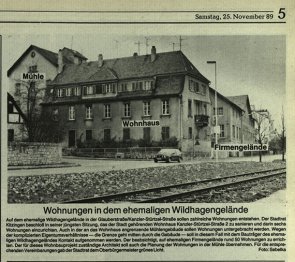
Finally, at its meeting on 23 November 1989, the Kitzingen city council decided to renovate the residential building at Kanzler-Stürtzel-Straße 2, which belonged to the city, and to set up six flats in it.
New flats were also to be built in the mill building adjacent to the residential building. In addition, the property developer "Wohnbau Schenkel" of the former company premises on Glauberstrasse intended to demolish the buildings of the old sweet factory and build new residential buildings here. In 1991/1992, the "Mainaue" residential complex was built on this site.
Sources:
- File of the city magistrate of Kitzingen: I/A/8/02: Decorations and decorations of honour, 1871 - 1904.
- File of the city magistrate of Kitzingen: I/A/8/22: Honours, 1905 - 1914.
- Civil rights files: No. 210: Wildhagen, Hermann Julius, 1893. No. 227: Wildhagen, August, factory owner, 1900. No. 308: Wildhagen, Richard, merchant, 1914.
- Council minutes since 1945
- Falkenstein, Stephanie: The Wildhagenvilla. A contribution to the residential and living culture of the Gründerzeit in Kitzingen. Publication series of the Städtisches Museum Kitzingen Volume 11, Kitzingen 2016.