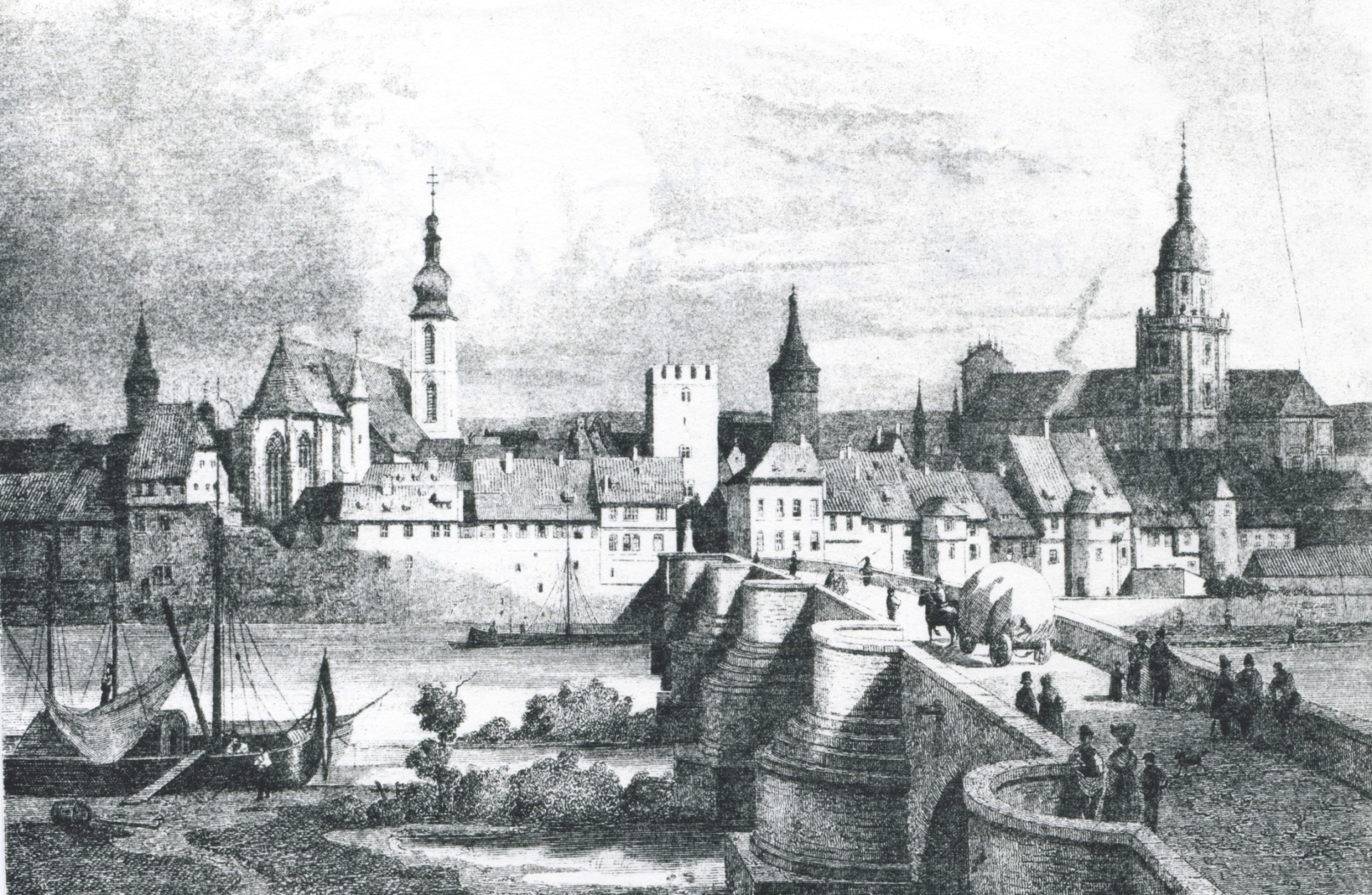
The history of Kitzingen begins in 745 with the founding of the monastery by Hadeloga, which is first mentioned in a document in 748. A settlement grew up around the monastery, which was named "villa Kitzingen" in 1040 and later developed into a town. From the 13th century, Kitzingen developed into a market town with important infrastructure such as the Old Main Bridge. In the 14th century, rule changed hands from the House of Hohenlohe to the Hochstift Würzburg, while important buildings such as the parish church of St John were built. In the 15th century, fortifications such as the Falterturm tower as well as fires and political changes characterised the townscape. The Peasants' War in 1525 brought severe penalties for the population. A new phase in the town's history began with the adoption of the Reformation in 1530 and the abolition of the monastery in 1544. The construction of the Renaissance town hall in 1561-1563 was the architectural highlight of this development.
Middle Ages
745 | Founding of Kitzingen Monastery by Hadeloga, according to legend a daughter of the Carolingian House-Master Karl Martell. She became the first abbess of the monastery. |
748 | The earliest evidence of the existence of Kitzingen Monastery is found in the biography of the first Fulda abbot Sturmius: "apud Kizinga monasterium". |
1007 | King Henry II donates the imperial abbey of Kitzingen to the newly founded diocese of Bamberg, thereby depriving it of its imperial immediacy. |
1040 | For the first time, a document of King Henry III mentions a "villa Kitzingen" (village settlement) near the monastery, from which the later walled urban settlement developed. |
1280 | Kitzingen is mentioned in documents as an "oppidum" (market town). |
1300 | The Old Main Bridge in the town of Kitzingen is mentioned for the first time in a document from the Hohenlohe region. |
1336-1381 | Kitzingen passes from the sovereignty of the Counts of Hohenlohe to the Hochstift Würzburg. |
1344 | The brothers Rüdiger and Wolfram Teufel, born in Kitzingen, and Konrad Groß, mayor of Nuremberg, founded a hospital in Kitzingen to provide accommodation and care for the elderly and sick. |
1400-1487 | Construction of the Catholic parish church of St John in the late Gothic style. The church is the oldest surviving building in the town. |
1443 | Kitzingen is pledged by the indebted Hochstift Würzburg to the Margraves of Brandenburg-Ansbach for 39,100 guilders, subject to the right of redemption. |
1469-1496 | Construction of the Falter Tower as part of the outer fortification wall. The tower stands 52 metres tall and, until 2011, housed the German Carnival Museum, which opened in 1967. |
| 1482 | First German wine law |
1484 | Serious fire in the monastery. Some of the monastery buildings and the church burn down almost completely and valuable archives are destroyed forever. |
1525 | Numerous people from Kitzingen take part in the peasants' revolt. After it is suppressed, 60 of them are punished by Margrave Casimir with blinding and expulsion from the town. The town itself has to pay a fine of 13,000 guilders and repair the destroyed monastery buildings and the monastery church. |
1530 | Margrave George the Pious of Brandenburg signs the so-called "Augsburg Confession" before Emperor Charles V at the Imperial Diet, thus finalising Kitzingen's accession to the Reformation. |
1544 | Margrave Georg Friedrich von Brandenburg abolishes the Benedictine convent in Kitzingen. Under the direction of a margravial official, a noble nunnery is established in the buildings. |
1561-1563 | Construction of the town hall in the Renaissance style by master builder Hans Eckart of Schaffhausen. |