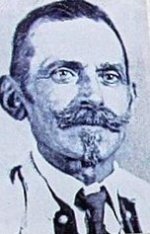
Born on 9 October 1882 in Segnacco (province of Udine), Anselm Caliz came to Germany at the age of nine and found work in a brickworks near Penzberg in Werdenfelser Land. After marrying Anna Klarwein from Farchant, he settled in the community in 1913 and moved into the house he had built himself in December. However, his happiness was short-lived, as the family was interned in Peißenberg in 1915 after Italy entered the war and had to give up their home.
Caliz came to Eibelstadt in Franconia in 1917 on a contract from his construction company, from where he travelled to Kitzingen at the end of the First World War to work on the construction of water pipes, where he also interpreted for Italian and French prisoners of war at the airfield. Caliz was only able to maintain contact with his family, who still lived in Eibelstadt, with a special permit and after a long walk. After the end of the war, the family was to be deported to Italy. Only the help of Hans Hartmann, a member of the Sulzfeld state parliament, freed him from all the bureaucratic pitfalls and the Caliz family was allowed to stay in Germany forever. Kitzingen, which had just over 10,000 inhabitants at the time, became their new home.
At the time, finding a flat was extremely difficult for a foreigner from a country that had been at war with Germany. Three flats in the old town were only a temporary and unsatisfactory solution for the newcomer. The family felt isolated and unaccepted. There was a great desire for independence and Caliz saved hard until he had the money together to purchase the plot of land on parcel number 5792 next to the district poultry farm with an area of 1890 square metres from the town of Kitzingen on 28 May 1921. As it was so remote and the area on Galgenwasen with its trees and sandy fields was more like a wilderness, it only cost DM 1,500.
Caliz cleared the site himself and felled 57 trees to turn the impassable terrain into a building site. He obtained the stones he needed to build his house from quarries in Hohenfeld and Albertshofen. Construction foreman Fischer from the company Benz und Schardt drew up the plan. As a trained bricklayer, Caliz knew how to deal with all the technical problems. He cooked his meals outdoors on the building site.
He worked tirelessly on Sundays and after work, and the family was able to move into the new home in the same year after the first room was completed. However, the necessary drinking water still had to be brought in daily from the "Gollers-Mühle" (later the Goller sawmill) on Sickershäuser Straße.
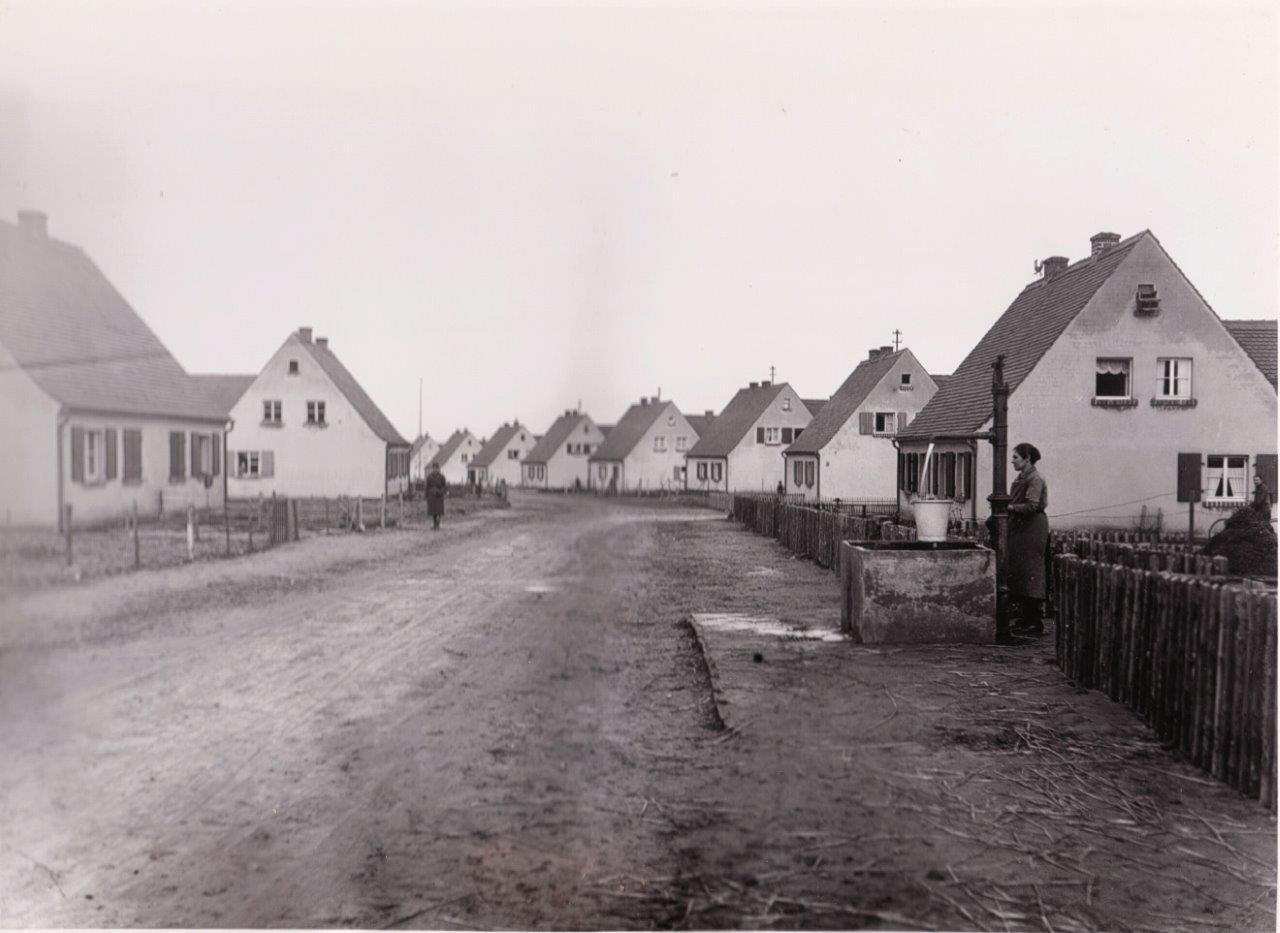
However, it took a total of two years to build the house. Caliz dug a well right next to the house, cleared a piece of woodland and planted a vegetable garden. With this pioneering achievement, Anselm Caliz became Kitzingen's first settler. His departure from the old town into the wasteland of sandy fields, spruce trees and a small pond had a signalling effect. It signalled the start of Kitzingen's new settlement on the outskirts of the town.
In 1929, Anselm Caliz finally found a job directly in Kitzingen, working as a bricklayer in the construction business of Benz & Schardt until 1937. He then went to work as a bricklayer at the Gebrüder Schmidt gingerbread factory in Mainbernheim. During the last years of the war from 1943 and for many more years after that, he worked in the Kitzingen area to supplement his small pension.
Anselm Caliz's wife Anna died in 1956. After her death, he lived with the family of his eldest son Michael in his own home at Texasweg 3, built in 1921. His last major public appearance was at the Siedler-Kirchweih in August 1963, when he rode in an open carriage in the procession together with Lord Mayor Dr Oskar Klemmert. Anselm Caliz died in Kitzingen on 3 April 1964 after suffering from a stomach ailment.
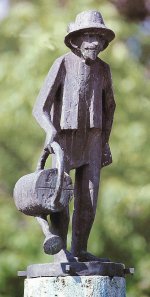
The Kitzingen artist Klaus Rother created a beautiful memorial to the founder of the settlement, Anselm Caliz, whose friendly nature and willingness to help made him popular everywhere, in front of the Siedlung main and primary school with a fountain figure (bronze on a shell limestone column) created in 1965. It depicts a hard-working settler with a gardening apron and watering can. The name Caliz will forever be inextricably linked with the estate.
Literature: Kitzinger Zeitung of 4 April 1964, 6 October 1962 and 8 June 1974.