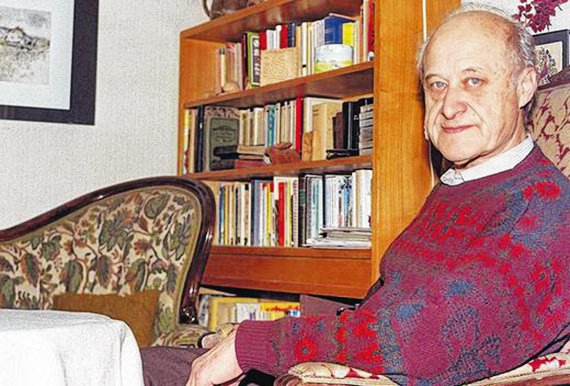
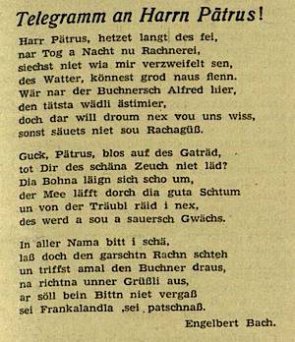
The well-known local and dialect poet Engelbert Bach was born in Kitzingen on 7 April 1929. His father was the craftsman and long-serving town councillor Franz Bach (1899–1977). He trained as an upholsterer, passed his master’s examination and took over his father’s interior design business in 1955, before attending three semesters of literary history and philosophy as an auditor at the University of Würzburg between 1957 and 1958. Shortly after completing his apprenticeship as an upholsterer, Engelbert Bach made his first literary appearance, namely as a co-creator and scriptwriter of the so-called ‘Häckerchronik’ to mark the town’s 1200th anniversary in 1951 (in this chronicle, the history of the town of Kitzingen is portrayed in various scenes by amateur actors in the local dialect). It soon became clear that the young Bach was multi-talented, for the then 22-year-old not only wrote a considerable portion of the chronicle, but also played the Häcker – that is, the narrator who delivers the transitions between the individual episodes – at the premiere.
From the very beginning, this intelligent, cosmopolitan master upholsterer was actively involved in the literary and local heritage sections of the newly founded adult education centre, and became well known throughout the Franconian region for his poetry readings. From 1960 onwards, Bach published numerous poems and stories annually in the ‘Kirchweihgeneraler’ to mark the ‘Ebshäuser Kerm’ and, under the pseudonym ‘Moustgoicker’, in the ‘Kitzinger Zeitung’. Furthermore, from 1964 he worked as a contributor to Bayerischer Rundfunk at Studio Franken, where he had his own dialect programme. His career there began as a dialect speaker in a feature on the reconstruction of Würzburg. Later on, he worked as an author of radio dramas and various dialect pieces. Bach also directed the amateur theatre group of the Kolping Society and appeared as a carnival speaker for the Kitzingen Carnival Society.
The master upholsterer from Kitzingen was regarded as the philosopher among Franconian dialect poets. His imagination and wealth of ideas were inexhaustible; his humour was subtle and refined. Bach was a keen observer of people in their daily lives, scrutinising their thoughts and recording the Franconian countryside and how people live within it and interact with it. However, he never sought to be funny at any cost. The artist provided the backdrop to many Christmas celebrations, wine tastings and cultural events in the district of Kitzingen. His numerous publications include ‘Plaudereien aus Franken’ (published in 1959), overheard by Engelbert Bach, ‘Fränkische Weihnachten’ (1963) and ‘Es bleibt kee Bee unterm Tisch’ (1970). In total, he published 15 volumes of poetry, most of them with the Marktbreit-based publisher Siegfried Greß.
On 7 April 1979, Engelbert Bach received the Cultural Prize of the town of Kitzingen on his 50th birthday. In 1985 he was awarded the Frankenwürfel, in 1992 the Steigerwald Club Culture Prize and in the same year the Culture Prize of the District of Lower Franconia, which he received on 12 January 1993. Despite all these honours, the artist has always remained down-to-earth and modest and has never put himself in the foreground. Bach, who was an integral part of the local cultural scene in post-war Kitzingen, died in Kitzingen on 4 November 1999 after a short, serious illness. A street in the "Buddental" housing estate in Kitzingen is dedicated to the unforgotten Kitzingen dialect poet Engelbert Bach, who was known far beyond the borders of Franconia.
volumes of poetry:
| 1959 | Chats from Franconia. Kitzingen |
| 1963 | Franconian Christmas. Gerabronn |
| 1970 | There is no Bee under the table. Marktbreit |
| 1971 | Schiessbuednbluma and other parish fair stories. Marktbreit |
| 1976 | Better healthy and rich. Marktbreit |
| 1978 | Twelve kilometres to Bethlehem. Marktbreit |
| 1980 | Mixed goods and haberdashery. Marktbreit |
| 1982 | Stars, straw and stables. Christmas traditions in the Lower Franconian dialect. Marktbreit |
| 1983 | The first fifty years. Marktbreit |
| 1984 | Vitus history. Market ride |
| 1986 | Nativity figures. Christmas stories and poems in Lower Franconian dialect. Marktbreit |
| 1989 | Johratag, poems in Lower Franconian dialect. Marktbreit |
| 1992 | Not one word too many. Marktbreit |
| 1995 | The festival. The preparations, the realisation and a happy ending. Volkach |
| 1999 | What are we waiting for? Volkach |