Bartholomäus Dietwar was born on 7 September 1592 as the son of the Kitzingen glass painter Elias Dietwar and his wife Margareta, daughter of the Kitzingen organist Paul Brückner, in Kirchgasse opposite the Catholic rectory. His father Elias came from Markelsheim and enjoyed an excellent reputation as a glass painter, producing numerous stained glass windows for churches and monasteries in the diocese on behalf of the Würzburg Prince-Bishop Julius Echter. Like many other Protestants, Elias Dietwar moved from Würzburg to the Protestant town of Kitzingen in 1588 for religious reasons.
The talented Bartholomew successfully attended the three-tier municipal Latin school, an institution of higher education that prepared him for university. In 1611, he enrolled as a theology student in Wittenberg, his studies made possible by a generous municipal scholarship. After completing his studies, he took up the pastorate in Hoheim in 1617 and married Maria Lehning, widow of Andreas Lehning, the former pastor in Castell, in 1618. The marriage was to remain childless.
Dietwar served the parish of Hoheim until the transfer of Kitzingen to the Hochstift Würzburg, which was completed in 1629 and resulted in the emigration of many Protestant inhabitants, as well as from February to November 1632, during the Swedish interim government. From 1630 to 1631, he held the pastorate in Stierhöfstetten.
On 12 November 1632, the mayor of Kitzingen at the time, Johann Steinmetz, appointed him chaplain in Kitzingen on behalf of the council, and on 26 May 1633 he was formally installed as a deacon. Less than two years later, the political tide turned again and Dietwar, who had been widowed since 1634, had to leave the town like all other Protestant pastors on the orders of the new sovereign, the Bishop of Würzburg. He moved into exile in Mainbernheim and married Regina Zapff, the daughter of the pastor of Repperndorf and Buchbrunn, on 26 May 1635.
His exile in Mainbernheim lasted three years, after which the pastorate in Gnodstadt became vacant and the Margraves of Brandenburg-Ansbach appointed Dietwar as the new pastor. He took up his duties on 27 February. His first child was born in Gnodstadt on 7 November 1638: a son named Johannes, who died a few months later. The girl Barbara, born two years later, also only lived for a few weeks. On 6 April 1642, the third child, Barbara, was born and on 28 December 1643, his son Johannes Vitus was born, who only lived for a short time.
In his chronicle, Dietwar describes the six years in Gnodstadt as a time of "much poverty, misery, hardship and danger", so that the family was overjoyed when Dietwar was called away to Segnitz as pastor, where he preached his first sermon on 15 November 1644. Four more children, including twins, were born in Segnitz and all three died within a very short time. On 8 July 1658, after a long illness, his beloved wife Regina died at the age of 45. Of the eight children, only his daughter Barbara was alive at this time; she ran the household for her father until her marriage in 1663.
Bartholomäus Dietwar carried out his duties in Segnitz until August 1670 without any assistants. He then suddenly fell ill with red dysentery and died on 20 August 1670 at the age of 78 and was buried "with the greatest sorrow of his entrusted sheep in the midst of a large crowd from the local and neighbouring towns". He had been a Protestant pastor for 53 years.
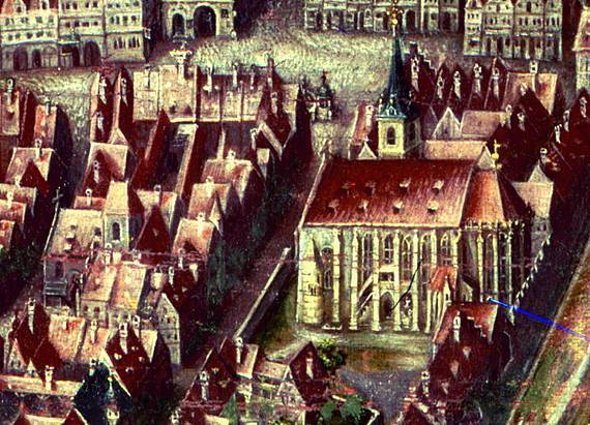
Bartholomäus Dietwar rendered great services to his home town of Kitzingen not only as a pastor, but also as a historian. In 1665, he completed the work "Historischer Bericht von dem Closter und Stadt Kitzingen in Francken". In it, Dietwar describes the history (foundation, development, coats of arms, dominions, significant events and buildings) of the town and monastery. In this context, he also describes the Old Main Bridge with its many superstructures such as the customs house, bridge tower and Naschkorb. Another highly interesting chapter is entitled "Register of the holy, praiseworthy and worthy sanctuary of Kitzingen Monastery". In it, Dietwar lists in detail the individual locations of the monastery's relics.
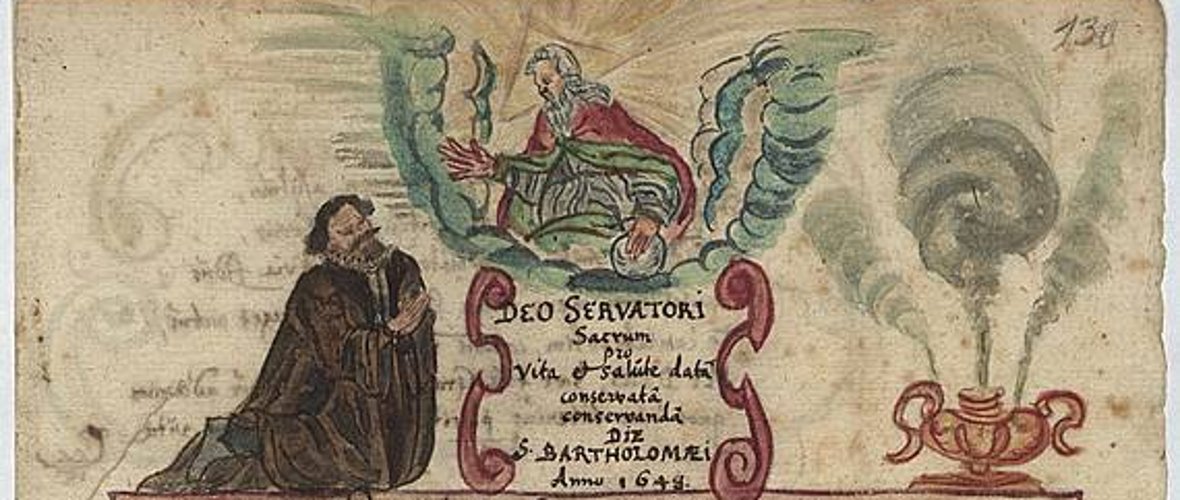
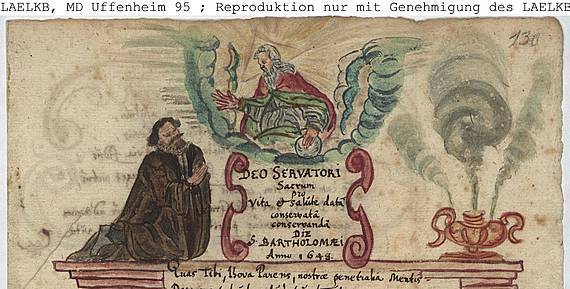
Written in 1648, his chronicle of the "Life of a Protestant pastor in the former margravial district of Kitzingen" is a valuable contemporary description of the events of the Thirty Years' War in Kitzingen. It is richly decorated with numerous coloured drawings, including pictures of Dietwar himself and his family. Dietwar begins his memoirs with the year of his birth in 1592 and ends in 1669, one year before his death. He chronologically reports on important municipal and ecclesiastical events, as well as family events, e.g. the composition of the town regiment, the election of a new dean, building projects, the weather, crop failures, prices, inflation, famine, illness (plague) and deaths. At the centre, however, is a very detailed description of the most important events in the Thirty Years' War in Kitzingen and the surrounding area, such as mustering, quartering, plundering, battles and troop marches. The dispute between the Margraves of Brandenburg-Ansbach and the Prince-Bishop of Würzburg over the redemption of the pledged town of Kitzingen, its prehistory and the consequences of re-Catholicisation are also dealt with in longer sections.
Literature: Bartolomäus Dietwar. Life of a Protestant pastor in the former margravial district of Kitzingen from 1592 to 1679, published with explanatory additions by Volkmar Wirth, second pastor in Mainbernheim. Kitzingen 1887.