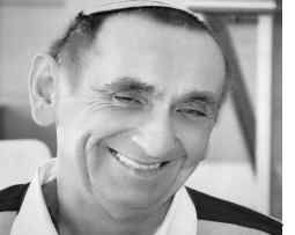
In October 2014, Michael Schneeberger, a Jewish local historian and genealogist, passed away. Regional historical and remembrance work owes a great deal to him. He bequeathed his collection to the Jewish Community, and it is now being transferred to the Johanna Stahl Centre.
One might have taken him for the reincarnation of a Franconian Jew from the time before the Shoah. If one did not know better: that this particular form of Jewish identity, this archetype of a Franconian country Jew, no longer exists. And that Michael Schneeberger was born on 6 April 1949 as a non-Jew.
And yet, his lived Jewish identity and his unmistakable Franconian accent reinforce this image. After years spent in various places – and perhaps also years of searching for meaning – he came to recognise the Jewish faith as the right path for him during a long stay in Israel in the late 1970s, and converted to Judaism. However, his plan to spend the rest of his life in Israel was thwarted by serious health problems. These were to accompany him for the rest of his life: everything he achieved, he had to wrest from his body.
He returned to Germany, to Kitzingen in Lower Franconia, and began to practise and shape his Jewish faith there. As a deeply religious and devoted member of the Jewish Community of Würzburg and Lower Franconia, he became actively involved in the life of the community. At the same time, he began to explore the remnants of Franconian Jewish life in his region. Practising his faith, uncovering the traces of Jewish people in the region, in Lower Franconia and beyond, and establishing contact with those who had been displaced became the focus and the personal commitment of his life.
Many have benefited from his dedication – yet Michael Schneeberger received no awards, medals or honours, apart from a certificate of honour from the Kitzingen Friends’ Association (2011). He was too modest to promote himself or his work. And he could be a steadfast, unyielding voice of warning who did not seek the limelight or curry favour in order to be honoured. Only now, following his death, has the Kitzing Town Council unanimously resolved to install a commemorative plaque in the Kitzing synagogue in his honour. It would not be entirely unreasonable to expect a posthumous honour from the State of Bavaria either.
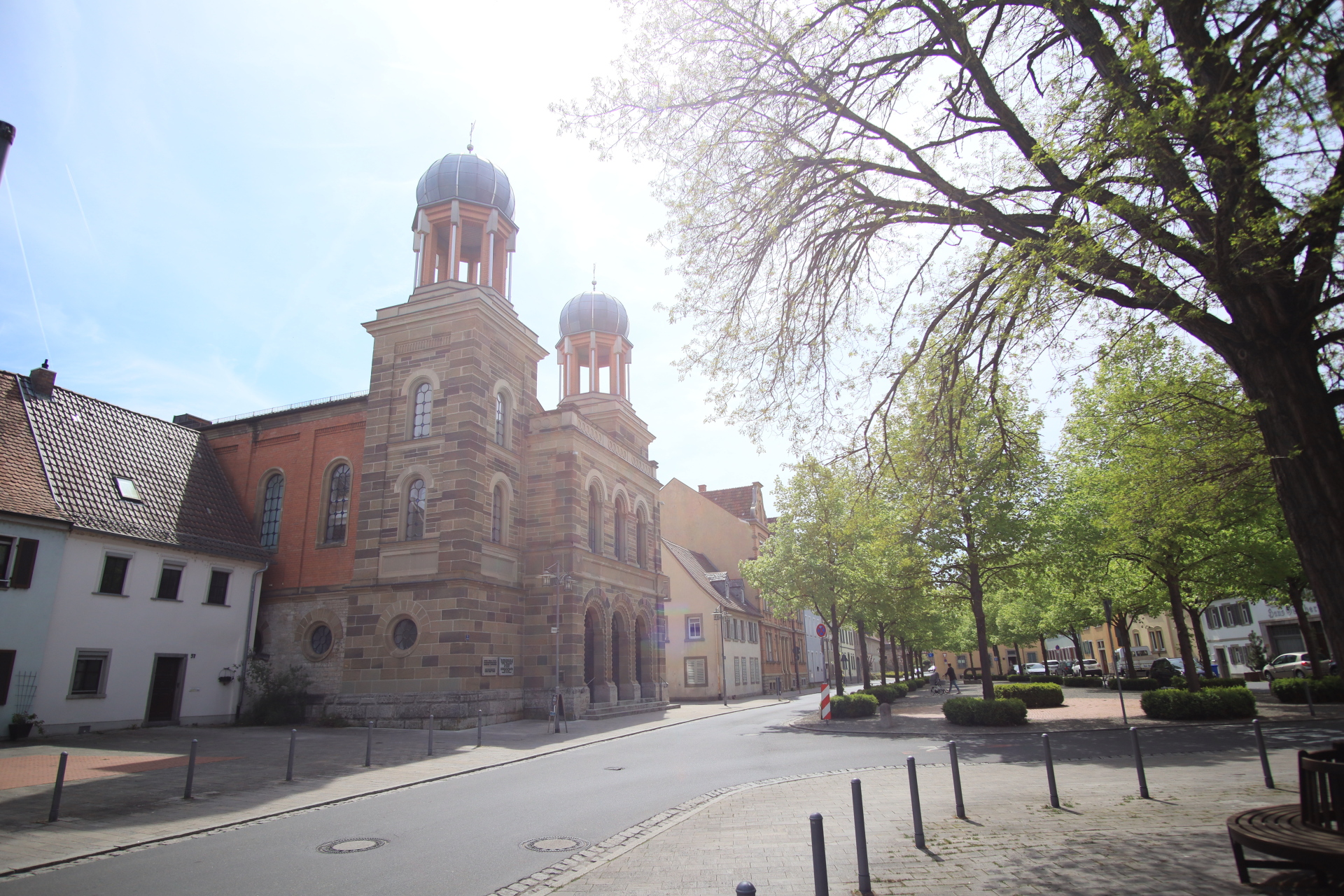
The first major project to which Michael Schneeberger devoted himself was the campaign to rebuild and repurpose the local synagogue, which had been destroyed in 1938. In 1982, he was one of the founders of the Förderverein ehemalige Synagoge Kitzingen am Main e.V. (Friends of the Former Synagogue in Kitzingen am Main) and, following a hard-fought political campaign, was able to help inaugurate the restored synagogue in 1993. Since then, it has been used by the town, the adult education centre (VHS) and the association for cultural purposes.
Prompted by the wishes of Israeli friends, Schneeberger devoted himself to Jewish family history research from 1985 onwards. He carried out well over 500 research projects, both large and small, mostly on behalf of relatives or descendants who, living abroad, lacked the resources and, increasingly, the language skills to do so themselves. The contacts he forged with these people and their families, as well as the connections that arose from them, became an important source for his work and enabled him to remain closely attuned to the people and their stories, even in his published accounts.
Schneeberger was a self-taught scholar who devoted himself to local and family history with a high degree of expertise and a meticulous, scholarly approach – something that is by no means a given. And, again not to be taken for granted, whilst recognising the importance of contemporary remembrance culture, he took a view that encompassed the entire span of Jewish history, not merely the period of persecution under Nazi rule. His skills in source analysis and his profound knowledge of Jewish religion and culture made him a sought-after expert and, moreover, a speaker at a wide range of events. And yet – presumably out of painful experience – he harboured respect, if not fear, of academically trained historians and usually kept his distance from them. Only now are their representatives beginning to realise just how innovative Schneeberger’s approach to commemorating those who were expelled and murdered was.
Schneeberger was unable to secure a stable livelihood through his work; he is variously and euphemistically described as a ‘bon vivant’. For him, his personal commitment was the top priority. It was therefore a source of satisfaction and recognition that, from 2002 onwards, he was able to secure an employment contract for at least ten years through the Ephraim-Gustav-Hoenlein Genealogy Project run by the Ronald S. Lauder Foundation.
Apart from his genealogical research, which extended beyond his home region and for which he visited archives both at home and abroad, he focused his research primarily on Kitzingen and the surrounding area. The Jewish cemetery in Rödelsee, the deterioration of which he witnessed first-hand, was a central concern for him. For here, too, traces of the Jewish people from Kitzingen and the region could be found.
Together with the photographer Christian Reuther, he carried out an outstanding historical and artistic project that attracted attention throughout Germany: large-scale photographs of a number of gravestones – some of which were already heavily weathered or damaged – taken at night and under spotlights were juxtaposed with the history of the people buried there and their families. The exhibition has been on display since 1993 in Berlin and Kassel, amongst other places, and a catalogue was published.
This project formed part of Schneeberger’s main theme of commemorating the Jewish families of Kitzingen. To this end, he produced an initial draft of a memorial book in 1996, the final version of which was eventually published in 2011 in collaboration with other authors, in both German and English. It goes far beyond what is presented elsewhere under this title, as it encompasses not only the biographies of those who were murdered, but also those of all other families born or resident in Kitzingen, including those who survived the camps and those who managed to escape. It is also valuable because so many personal accounts have been incorporated into this book.
Finally, the Jewish rural communities in Bavaria form the third focus of his work. Since 2002, he has published a series on this subject in the journal of the regional association ‘Jüdisches Leben in Bayern’ (Jewish Life in Bavaria): in almost every issue since then, a total of 37 articles have appeared, each focusing on one or more rural communities in Bavaria, with detailed references to their sources. It would have been so good if Michael Schneeberger had been granted the time to continue this work. In addition, he published a number of other essays on families and communities in Obernbreit, Marktbreit, Heidingsfeld and Obernzenn.
We can no longer draw on Michael Schneeberger’s vast knowledge. However, he meticulously recorded and filed the results of his research. This collection will now have to answer our questions – and it remains accessible to local history research. This is because Schneeberger bequeathed this collection to the Jewish Community in Würzburg, which, with the family’s consent, has decided to donate it – with a few exceptions – to the Johanna Stahl Centre for Jewish History and Culture in Lower Franconia, located in the same building. Subject to the approval of the district committee, it will be incorporated into the centre’s collection, catalogued, and may one day be made available for specific research purposes.
A preliminary, rough catalogue of the holdings will be posted on the Centre’s website as soon as possible. This will also highlight their great value, as much of what Schneeberger compiled remained unpublished: in particular, finding aids for the sources of individual parishes, including all those from the former Kitzingen rabbinate, as well as the more than 30 comprehensive family histories and his lectures.
On 13 October 2014, Michael Schneeberger lost his battle with the many illnesses afflicting his body. Two days later, he was buried at the Jewish Cemetery in Würzburg. It is only now that some people are truly realising what they had in him – and what they have lost.
Source: Rotraud Ries