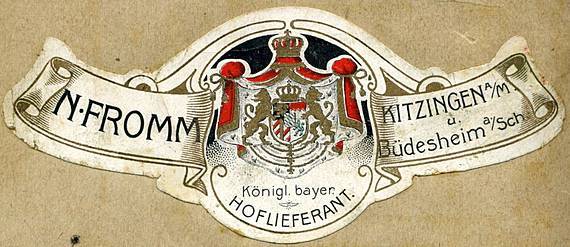
Max Fromm came from Großlangheim. He was born there on 1 June 1873 as the son of the Jewish wine merchant Nathan Fromm and his wife Marie Klein from Memmelsdorf. At the beginning of 1896, he moved his residence to Kitzingen to the newly built magnificent house at Bismarckstraße 5, although the Fromms' wine wholesale business had already been located at Wörthstraße 12 since 1892, meaning that their home and business premises were in the immediate vicinity.
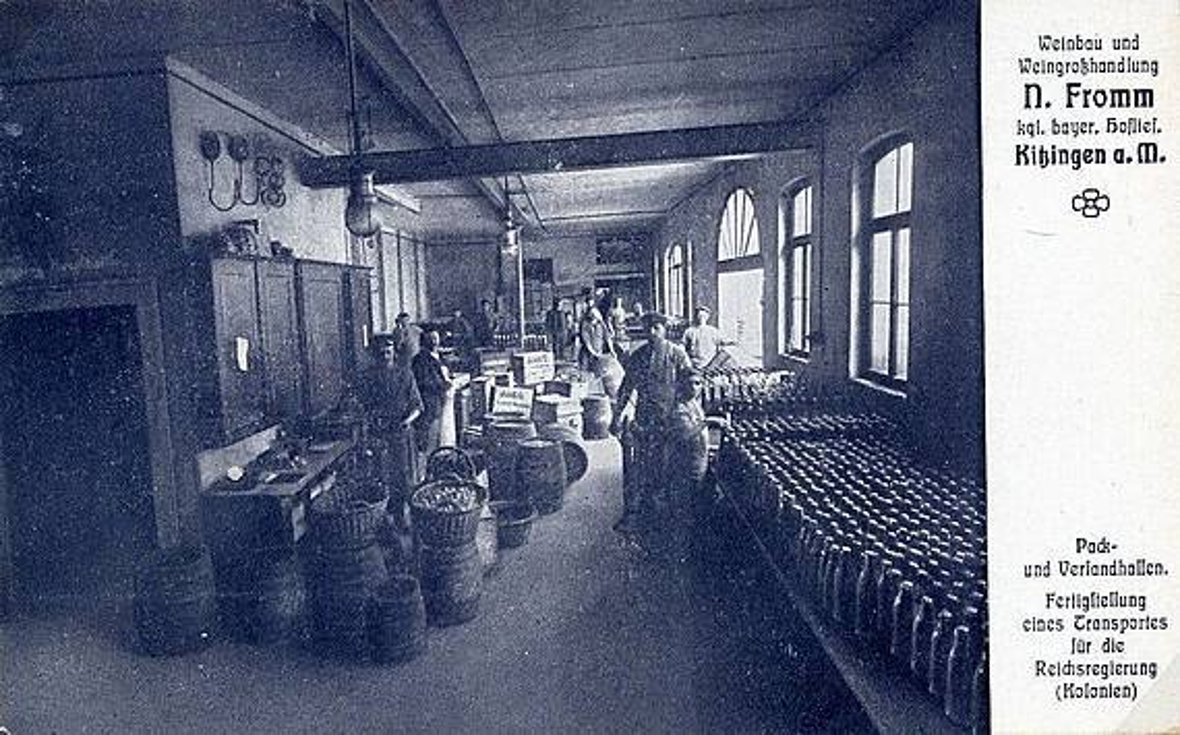
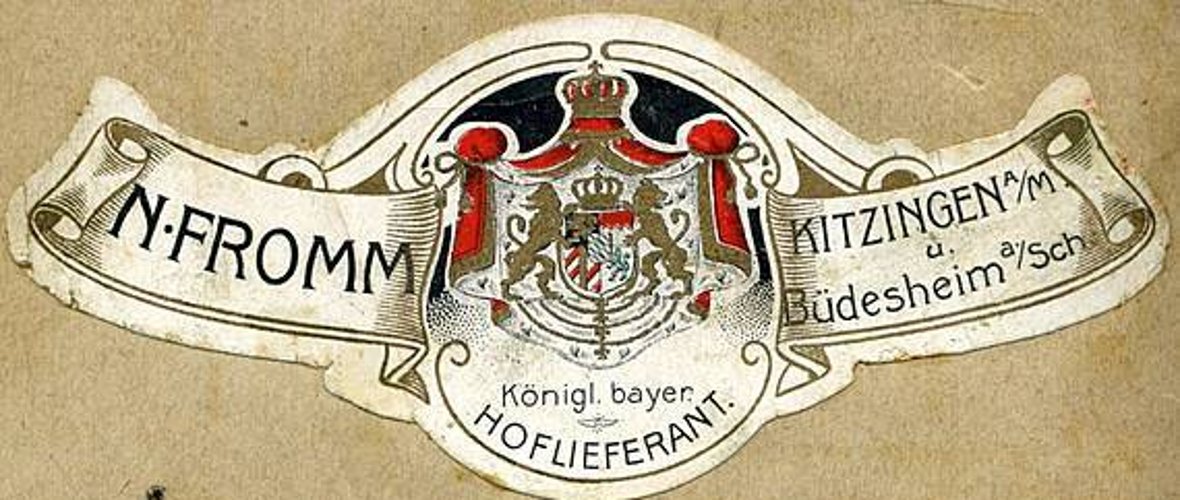
Max Fromm, Royal Bavarian Purveyor to the Court since 1911, was a leading wine expert and entrepreneur in his sector. The basis for the enormous rise of the company was the wine expertise of its owner, combined with an exceptionally good commercial aptitude. This was complemented by a decidedly "gifted wine tongue". Fromm was regarded as an "artist of taste" and a master at blending wines to suit customers' tastes. He was constantly working on improving cellar technology and the storability of the wine. Despite the difficult times during and after the First World War, he succeeded in constantly expanding the company and increasing turnover through innovations in cellar technology and improvements to the business environment. At this time, the Nathan Fromm wine wholesale business was the largest company in Kitzingen with 89 employees and was one of the largest Jewish wine merchants in Germany. Fromm's turnover in the 1920s is estimated at more than half of all wine sales in Kitzingen.
Max Fromm was regarded as a generous and extremely social entrepreneur. The wages and salaries for his employees were fair and good, the working hours complied with legal regulations, and he always behaved correctly towards business partners and employees. He maintained very friendly relations with his employees. In times of need due to the war, he donated wood and coal, was strongly committed to the families of his employees and supported them over the years in the form of monetary and material donations.
In May 1921, Max Fromm emerged as co-founder and main initiator of the "Bocksbeutelweinvertreibs fränkischer Weingutsbesitzer". This saw itself as a supra-regional association of Franconian winegrowers, which already had 35 members within a year. In this context, Fromm was also responsible for reviving the tradition of the Bocksbeutel as a trademark for Franconian wines. Good Franconian wine in the characteristic, eye-catching bottle shape was sold throughout Germany in future. In 1924, Max Fromm was awarded the honourable title of "Kommerzienrat" for his services to the economy of Kitzingen.
Fromm also had an influence on the town as a politician. He belonged to the liberal German Democratic Party and was elected Kitzingen's first Jewish councillor in 1919. He held this office until he moved to Bingen in 1929. However, Max Fromm was not only a businessman and politician, he also had an extremely keen appreciation of art and frequently appeared as a generous patron of the arts for the town of Kitzingen, thus contributing to the beautification of the townscape. In 1911, for example, he donated a new decorative fountain on the corner of Bahnhofstrasse and Bismarckstrasse, the "Hadla Temple" near the Falter Tower and a large decorative flower vase in front of Ranck's house at Bahnhofstrasse 1.
Max Fromm's company grew steadily, so that the cellar capacities in and around Kitzingen were no longer sufficient. His major customers included Mitropa and German Lloyd. Unfortunately for many people in Kitzingen, he moved his company headquarters to the centre of the German wine trade, Bingen am Rhein, in 1929.
The Nazi dictatorship forced Max Fromm to emigrate to London in 1939 and finally to the USA in 1941 to join his son Alfred, who founded one of the very early Californian wine trading companies with Franz Sichel in 1936. Max Fromm put all his skills and knowledge at the disposal of Fromm & Sichel. After Max Fromm had visited his home in Lower Franconia once again after the end of the war, he died in San Francisco in 1956. In his memory, the Kitzingen town council unanimously decided at its meeting on 8 December 2005 to name a new street in the Hammerstielweg development area after Max Fromm.
Literature: Elmar Schwinger: From Kitzingen to Izbica. The rise and catastrophe of the Main-Franconian Jewish community of Kitzingen. In: Schriften des Stadtarchivs Kitzingen (ed. Doris Badel), vol. 9, Kitzingen 2009.
Hartwig Behr: Fromm makes "Stürmer" headlines. In: Tauberzeitung from 5 September 2009