Andreas Schmiedel, born on 16 December 1829 in Thierstein, Upper Franconia, attended grammar school in Bayreuth and studied law in Erlangen, where he passed his first state examination in 1855 and his second in 1857. On 15 July 1858, he took up his first post in Kitzingen to assist Mayor Förster in his role as legal adviser. He held this position until 28 October 1859. Traces of his work during that period can be found primarily in the town archives, as it was Schmiedel who organised the registry and compiled a finding aid.
When Mayor Andreas Förster stepped down from office at the end of 1859 and moved to the Ebern District Court, Schmiedel took over the duties of the legally qualified mayor on an interim basis on 3 December 1859. He stood as a candidate in the election for mayor of the town of Kitzingen, which was held on 20 January 1860; he prevailed over eight rivals and was sworn in as the new mayor with legal expertise on 1 February 1860.
Schmiedel, a left-liberal Protestant, was a great champion of economic and cultural development across all denominational boundaries. The modernisation of the municipal community is directly linked to his name. During his term of office, which lasted until 30 November 1881, Kitzingen attained direct district status and the town’s expansion was completed. Beyond the town walls, extensive residential areas sprang up, and new streets, squares and green spaces were laid out. Old walls, gates and towers (including the Faltertor, the Brücken Tower and the Sixtenturm) were demolished to improve the town’s appearance; Kitzingen became a friendlier and brighter place, and the streets were repaved.
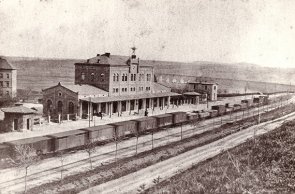
Further milestones in his political career included the connection of Kitzingen to the railway network in 1865, the re-establishment of a Jewish community – which culminated in the construction of a magnificent synagogue in 1883 – the installation of a new water main, a water and gas works, the expansion of secondary education to improve educational provision, and the establishment of a primary school library and a cooperative savings and loan association.
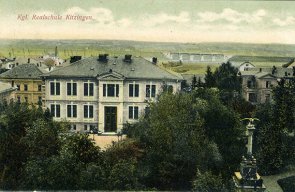
The vocational school in the Rosengarten, built in 1871 and situated in the immediate vicinity of Schmiedel’s home, was converted into a six-form secondary school in 1877. On the right-hand edge of the picture is the war memorial, unveiled in 1878, commemorating the successful war against France in 1870–71.
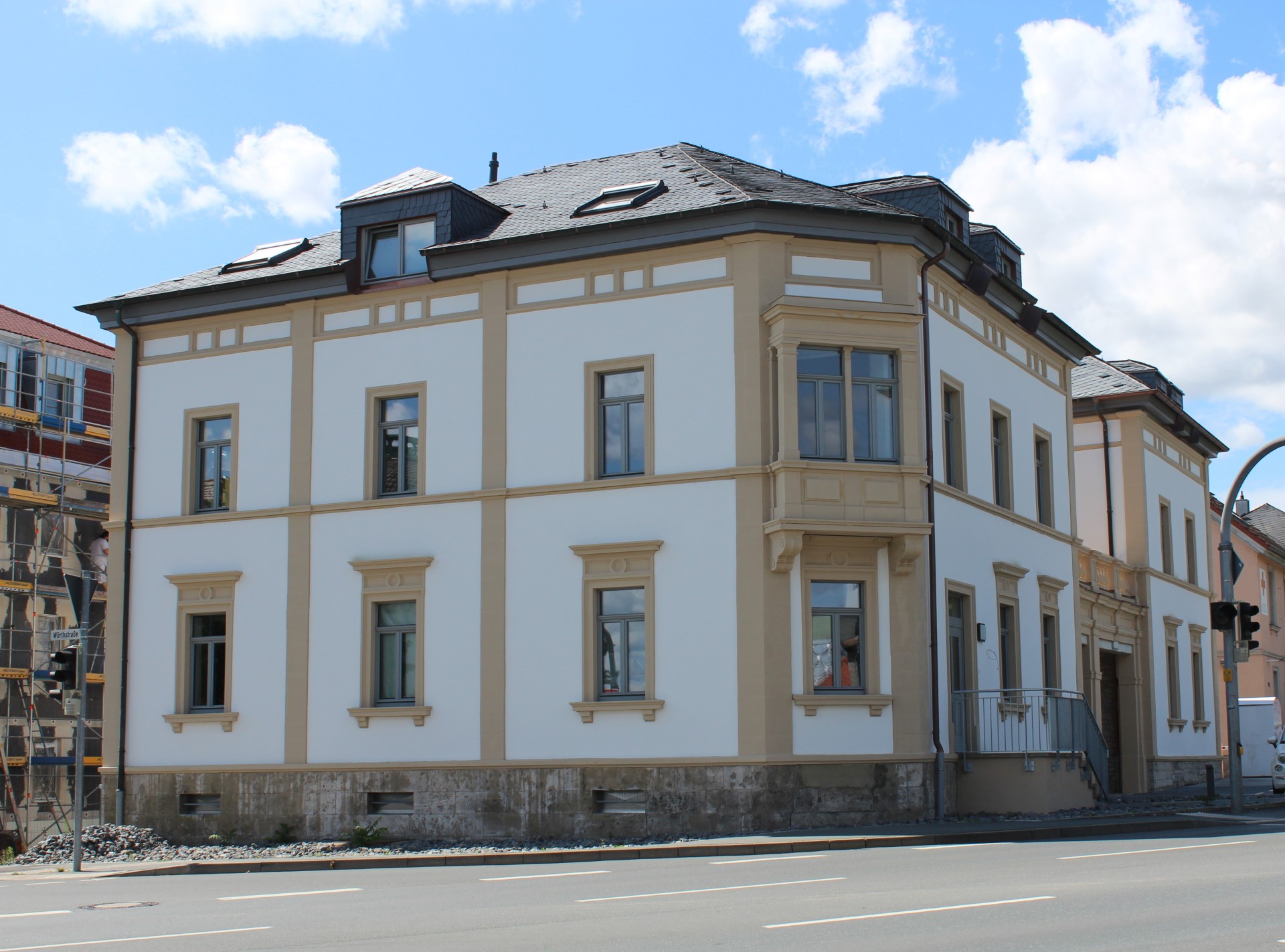
Andreas Schmiedel had been married since 1865 to Margaretha Barbara Gebhardt, the daughter of a wine merchant from Sommerhausen, who bore him three children but died four years after the wedding. His second wife, Julie (née Gründler), the daughter of a regional court assessor, whom he married in 1871, bore him a further three children. At that time, Mayor Schmiedel lived with his family outside the old town centre in his father-in-law’s newly built house at 861 Realschulstraße. Shortly after stepping down from the office of mayor, Andreas Schmiedel died on 17 August 1882 at the age of 53. Six years after his death, Realschulstraße was renamed Schmiedelstraße in his honour. The former address, Realschulstraße 861, corresponds to the present-day house number Schmiedelstraße 1.
Bibliography: Christian Wolfsberger: Kitzingen – Local Politics and the Modernisation of a Bavarian Town, 1818–1918, pp. 133–164. In: Mainfränkische Studien, Vol. 72, Würzburg 2005.