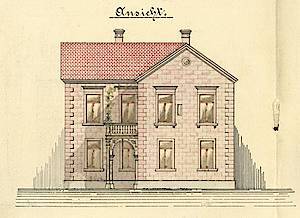
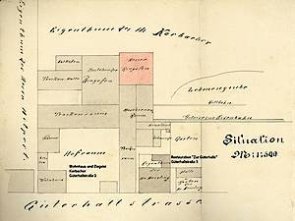
Michael Korbacher, born on 5 April 1861 in Waigolshausen (Schweinfurt district), was the son of Michael Korbacher, a local bricklayer and master builder, and his wife Barbara. He had been living in Kitzingen since 1882, was granted citizenship of the town in 1888 and married Eva Maria Eberth (1866–1939) a year later.
His elder brother Lorenz (1856–1891) had moved to the city on the Main as early as 1870, where he ran a bricklaying business. In 1879, he was granted citizenship of the town and married Katharina Lutz, daughter of the boatman Johann Lutz, who, however, had been running a field brickworks (lime and brick kiln) on his estate at Güterhallstraße 845 (renumbered 3 in 1900). Through this marriage, Lorenz Korbacher became a co-owner of the brickworks and eventually took full control of it following the death of his father-in-law.
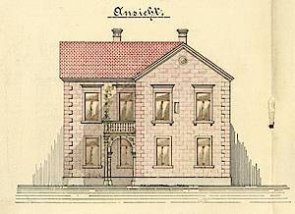
As part of the expansion of their construction business and the enlargement of the brickworks, the Korbachers built a second house at Güterhallstraße 16 in 1889. Until then, the younger Michael had been living with his brother Lorenz and his family at Güterhallstraße 3. After marrying Eva Maria Eberth that same year, he moved into this new building.
Little by little, the enterprising and hard-working brothers expanded their landholdings, which stretched from Güterhallstraße to the corner of Kaltensondheimer Straße and Friedenstraße, and erected new outbuildings, workshops, barns, timber and plank stores, office buildings and other extensions. From 1885 onwards, they ran the highly successful ‘Gebrüder Korbacher’ building firm at 5 Kaltensondheimer Straße and received numerous commissions. Following the death of Lorenz Korbacher on 25 September 1891, his brother Michael continued to run both businesses until his nephew Wilhelm was able to take over his late father’s brickworks.
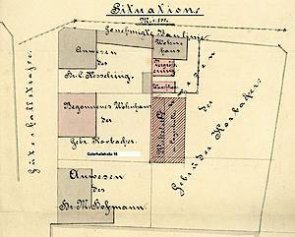
At the beginning of 1912, Michael Korbacher handed over his construction firm, which bore his name, to his site managers and long-standing employees Franz Benz and Johann Schardt, for reasons of age and ill health. In May 1912, they were awarded their first major municipal contract: the construction of the new waterworks at 23 Mainstockheimer Straße. Johann Schardt, born on 20 May 1877 in Marktbreit, had been living in Kitzingen since 1896. Following the death of his business partner Franz Benz in 1936, his son Georg Schardt joined the construction firm, which from then on operated under the name ‘Johann Schardt & Sohn’. The Second World War dealt a severe blow to the construction firm and the brickworks. During the devastating American air raid on Kitzingen on 23 February 1945, the company – which was situated in the immediate vicinity of the railway station, one of the main targets of the attack – suffered a total loss. However, father and son successfully rebuilt the business and led it into a new era of prosperity.
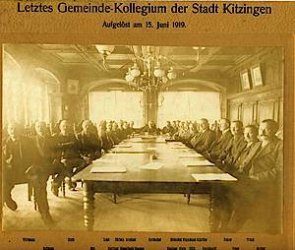
Back to Michael Korbacher! He had been a member of the municipal council since 1906 and was even its chairman from 1908 to 1919. Alongside the municipal executive, a council of municipal representatives acted as a further administrative body and representative of the municipality. The municipal council required the approval of the municipal representatives in matters including the leasing of property funded by the municipality or foundations, issues relating to salaries, the establishment of new municipal institutions, the construction of new municipal and foundation buildings, the purchase and sale of land, capital investments, various tax and fee regulations, and all matters relating to loans and debt.
In 1917, Korbacher was awarded the ‘Order of Merit of St Michael, 4th Class’. Mayor Ludwig Graff’s justification for this was as follows:
“He carries out his duties as a member of the Municipal Council in a generous and conscientious manner, and it is often thanks to his proactive intervention that major projects – including those with a view to Kitzingen’s future – are brought to fruition. Since the outbreak of the war, he has rendered outstanding service to the local municipal association, particularly in his capacity as head of the Reich Clothing Office. He is undoubtedly an extremely hard-working and capable chairman of the Municipal Council and is held in high esteem by large sections of the local population. He previously ran a building firm and also enjoyed a very good reputation as a businessman, having built his business up to a very respectable level. Korbacher is therefore nominated for the highest honour: the award of an order.”
Korbacher was a generous and forward-thinking man. In 1910, he commissioned the construction, at his own expense, of covered halls and playgrounds in the garden of the new Catholic nursery school at Ritterstraße 5, and also called for the construction of an overland electricity substation in Kitzingen that same year. He always regarded the “lack of electricity as an obstacle to the development of industry in this town” and warned against falling behind the surrounding communities, which were already connected to the regional power station.
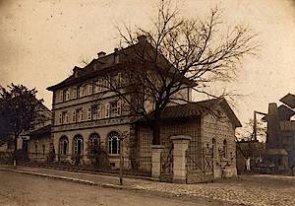
Michael Korbacher died on 13 June 1943 in Kitzingen. For a quarter of a century, he shaped the townscape of Kitzingen like almost no other. His name is associated with the construction of most of Kitzingen’s large villas (including those of the Buchner, Völker, Fromm and Heidingsfelder), spacious new streets (Bismarckstraße, Wörthstraße and Moltkestraße), as well as significant municipal and state buildings, including the municipal gymnasium and gasworks, the mortuary and the abattoir complex. In addition, alongside the planning architect and municipal building engineer Christoph F. Schneider, he was responsible as the chief contractor for the synagogue on Schrannenstraße, which was inaugurated in 1883. Many industrial facilities and residential buildings were also constructed under his supervision. For instance, he built the large hall of the ‘Fränkischer Hof’, the paint factory and villa belonging to Rometsch & Co, as well as the beer cellar, brewhouse and large stables of the Kleinschroth brewery.
Mayor Siegmund Graff honoured the Kitzingen master builder at the aforementioned award ceremony in 1917 with the following words:
"His entrepreneurial spirit led him to construct spectacular residential and commercial buildings, which had a positive impact on the influx of newcomers and tax revenue, and gave a tremendous boost to construction activity in general. His workers held him in high regard because he was always a fair employer and foreman to them."