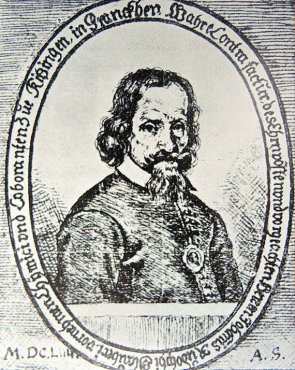
Johann Rudolph Glauber was born on 10 March 1604 in Karlstadt am Main, the son of a barber. He came from a large family and was orphaned at an early age. In his hometown, he probably attended a Latin school and completed an apprenticeship as a pharmacist. At the age of 21, he fell ill with typhus and was cured by drinking spring water. As a result of this life-changing experience, he resolved to study medicine for the benefit of others. He lived and worked in various places, including Vienna (1625), Salzburg, Gießen, Wertheim (1649–1651), Basel, Paris, Frankfurt am Main, Cologne and Amsterdam.
Glauber had been suffering from an insidious illness since as early as 1660, which was probably a case of poisoning resulting from his experiments. Ultimately, the chemist – who had been temporarily paralysed and had lost his sight as a result of his illness – was forced to sell the equipment from his laboratory and parts of his library in 1668 to ensure his family’s survival. Glauber had been bedridden since 1666; he died on 16 March 1670 in Amsterdam. A commemorative plaque in Amsterdam’s Westerkerk, his final resting place, honours his life and work.
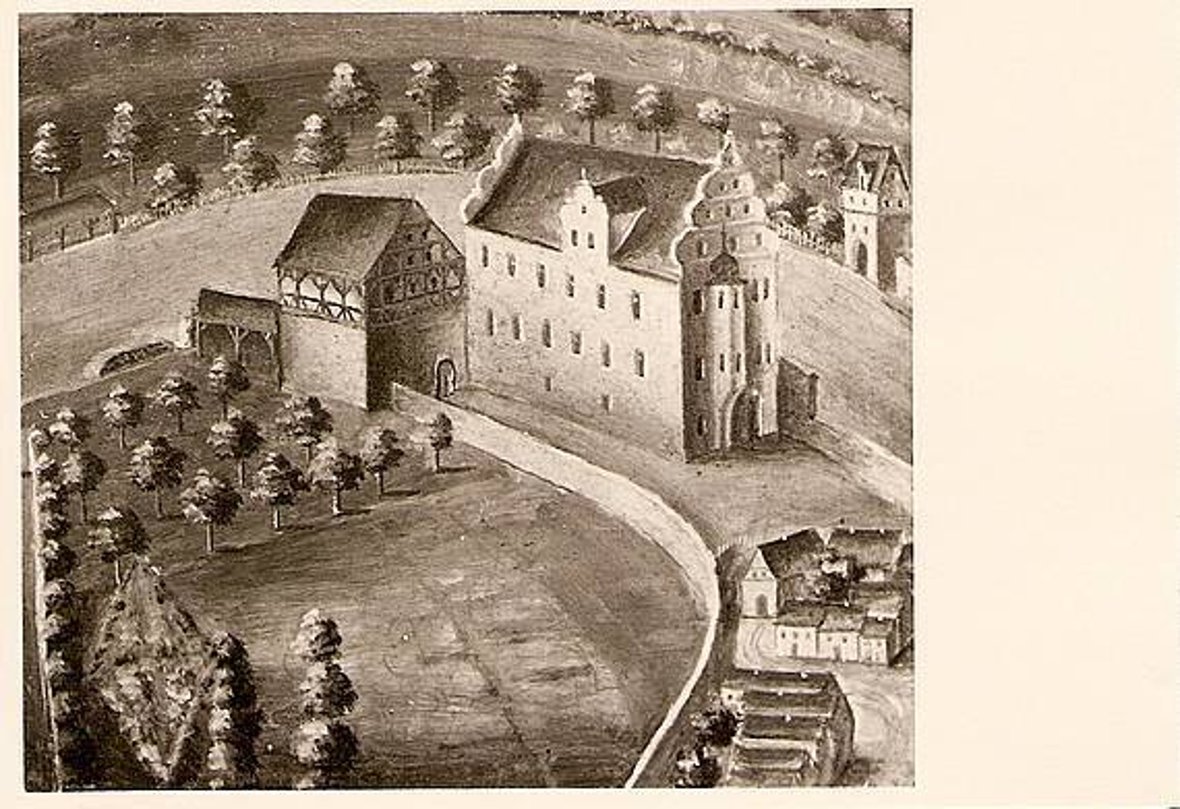
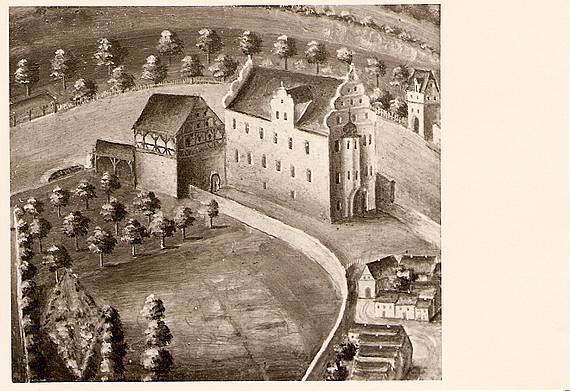
For two years – from 1652 to 1654 – Johann Rudolph Glauber had his laboratory in the former convent of the Benedictine nuns and his home at 35 Fischergasse in Kitzingen. It was here that he wrote one of his most important treatises on the production of tartar, as a special licence granted by the Prince-Bishop of Würzburg, Johann Philipp von Schönborn – a kind of right of first refusal – had enabled him to produce tartar on an industrial scale from the lees left in the barrels of Kitzingen’s winegrowers.
According to the Kitzingen oral tradition, he is also said to have sold medicines at the Löwen Pharmacy on the market square, which was founded in Kitzingen in 1623. It is not clear to what extent he required a licence to practise as a pharmacist in this instance.
His defence briefs against his former friend from his time in Kitzingen, the Speyer cathedral treasurer Christoph Farner, with whom he had fallen out, are the main source from which his biography can be reconstructed! It was probably hostility from the Kitzingen coopers – who were determined not to lose their source of raw materials for the yeast schnapps they distilled – that forced him to give up his residence in Kitzingen after only a short time. He left Kitzingen in 1654 and moved back to Amsterdam. There he had a large laboratory with six staff and a garden where he studied mineral fertilisers.
Even today, street names and a sign at the Löwen-Apotheke serve as a reminder of Glauber’s time in Kitzingen. These close ties between Glauber and Kitzingen prompted the Kitzingen Municipal Museum to join the initiative by the curators-in-training, Prof. Dr Helmut Gebelein, Justus Liebig University, Giessen, and Dr Rainer Werthmann, Kassel, to Johann Rudolph Glauber.
To accompany the special exhibition, work was carried out on reconstructing a spiced wine based on Johann Rudolph Glauber’s recipes. The attempts to reconstruct this spiced wine took around two years. Several fermentation trials were necessary, for which the Kitzingen-based firm Arauner was enlisted. During the regular wine tastings held in the old pharmacy of the Municipal Museum, new findings on optimising the wine were discussed with the two scientists, Werthmann and Gebelein, who were also conducting fermentation trials in parallel at Justus Liebig University in Gießen. The focus was on the proportions and fermentation of the individual herbs – particularly iris root and cardamom – as well as on finding the right base: which wine, and what sugar content?
This wine was last tasted in February 2008 and was generally deemed to be good. The ‘testers’ on this occasion were not only the museum director and Mr Peter Ley, the chemist, Löwen-Apotheke in Kitzingen, but also selected teachers from the Armin-Knab-Gymnasium in Kitzingen, who ultimately decided which of the many samples – whether tart or bitter, cloudy or clear – would ultimately be bottled.
It should be noted that the fermentation trials and repeated wine tastings were personally overseen with admirable patience by the managing director of Arauner, Wolf, Baron von Tautphoeus – the museum owes him a special debt of gratitude, as he repeatedly and willingly agreed to take part in new experiments!
The Glauber drink, which comes with a certificate, was produced and bottled by the Kitzingen-based company Arauner, featuring the award-winning logo design by Theresa Lang, winner of the label design competition organised by the Armin Knab Gymnasium as part of the ‘Glauber Project Day’.